

What Is a Landing Page and Why Does Every Campaign Need One?

A landing page is a standalone web page designed for a single, specific goal. It exists to convert visitors who arrive from a specific source (an ad, an email, a social post) into a specific action: signing up, requesting a quote, downloading something, or buying a product. Unlike a homepage or a service page, a landing page has no navigation menu, no links to other pages, and no competing calls to action. Everything on it serves one conversion goal.
Most marketing campaigns send traffic to the homepage. Most homepages try to serve every visitor type at once. The result is a friction-filled experience where the visitor who clicked an ad for a specific offer has to navigate through a general website to find what they were promised.
A landing page removes that friction. It picks up exactly where the ad or email left off, confirms the offer, and gives the visitor one clear path forward. The difference in conversion rate between sending paid traffic to a homepage versus a purpose-built landing page is consistently significant. This is why understanding landing pages is fundamental to any digital marketing campaign.
How Is a Landing Page Different from a Homepage?
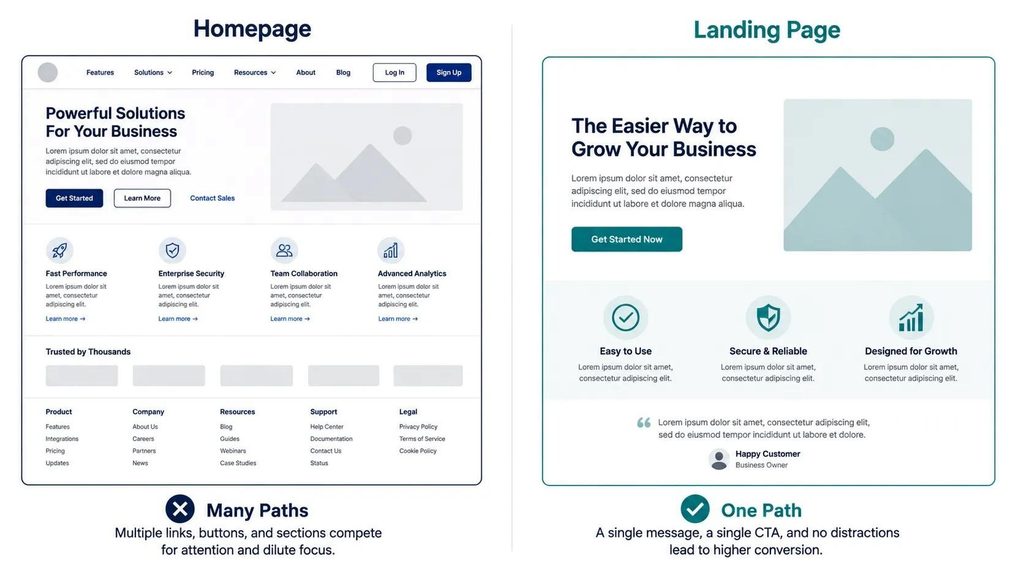
| Landing Page | Homepage | |
|---|---|---|
| Primary purpose | Convert one specific type of visitor to one specific action | Serve all visitor types; provide site-wide navigation |
| Navigation menu | None (intentionally removed) | Full navigation with links to all main sections |
| Number of CTAs | One (sometimes two, same action) | Multiple; varies by business |
| Traffic source | Specific: one ad, one email campaign, one social post | Multiple: direct, organic, paid, referral |
| Content | Focused on one offer, product, or message | Broad overview of the entire business |
| Optimization method | A/B testing specific elements (headline, CTA, form) | Harder to A/B test due to diverse traffic and goals |
| Lifespan | Often temporary, tied to a specific campaign | Permanent; core site infrastructure |
The no-navigation rule is the most counterintuitive part of landing page design for people building their first one. Every exit from a landing page is a conversion that did not happen. A navigation menu gives visitors six ways to leave before taking the action you want them to take.
What Are the Different Types of Landing Pages?
The right landing page structure depends on what you are trying to get the visitor to do.
Lead Generation Landing Page
The goal is capturing contact information, typically name and email, in exchange for something of value: a free guide, a consultation, a trial, or a quote. This is the most common landing page type for service businesses, SaaS companies, and B2B marketers.
The exchange needs to feel fair. The more information you ask for, the more valuable the thing you offer must feel. A form with 8 fields converts at a fraction of a form with 3 fields for the same offer.
Click-Through Landing Page
Used primarily in e-commerce, a click-through landing page pre-sells a product or offer before the visitor reaches the actual checkout or product page. Instead of capturing contact information, the goal is a click to the next step. The landing page does the trust-building and objection-handling work so the product page only needs to facilitate the purchase.
Sales Landing Page
A long-form page that contains everything needed to make a purchase decision: the full pitch, features, pricing, testimonials, objection handling, and a buy button. Common for higher-priced products or services where the visitor needs significant convincing before they are ready to commit.
Event or Webinar Registration Page
Focused on getting a visitor to sign up for a specific event. Usually includes the event date, time, speaker information, what attendees will learn, and a registration form. Short form (name and email) is standard since the commitment is low.
App Download Landing Page
For mobile app launches, a landing page bridges the gap between an ad and the App Store or Google Play listing. It showcases the app’s core value proposition, screenshots, and social proof, with a single CTA button that links to the app store listing. These pages are particularly useful when running paid campaigns to a cold audience who has not yet heard of the app.
What Makes a Landing Page Actually Convert?
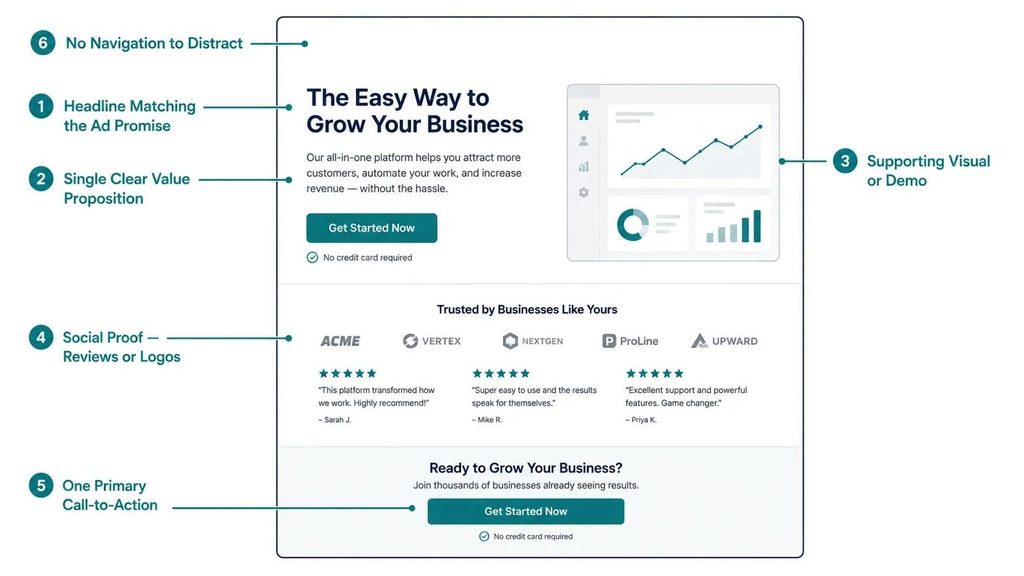
Conversion rate research from Unbounce, Instapage, and HubSpot consistently points to the same structural elements.
Headline That Matches the Ad or Link That Brought the Visitor
Message match is the most important single factor in landing page conversion. If an ad says ‘Get a free website audit,’ the landing page headline should say ‘Get Your Free Website Audit,’ not ‘Welcome to Our Services.’ Any gap between the promise that drove the click and what the visitor sees when they arrive creates doubt and loss of momentum.
One Clear Value Proposition
Above the fold, before the visitor scrolls, they need to understand: what is this, who is it for, and why should I care? That answer should be deliverable in one sentence. If you cannot state the value proposition in one sentence without qualifications and caveats, the page will not convert at a high rate because the page itself will not be focused enough.
Social Proof Relevant to the Offer
A testimonial from someone who used the same service you are offering on this page is more effective than a general company testimonial. ‘I got 12 qualified leads in the first month from this service’ converts better on a lead gen landing page than ‘Excellent company to work with.’
A Form or Button That Takes Minimal Effort
Lead generation forms: ask for the minimum information needed to follow up. Name and email for a content download. Name, email, and company for a B2B consultation. Add phone number only if the follow-up is a call and you have explained that. Every additional field reduces conversion rate.
The button copy matters as much as the form length. ‘Submit’ is the worst-performing button label. Specific action verbs tied to the outcome (‘Get My Free Audit’, ‘Book a Consultation’, ‘Download the Guide’) consistently outperform generic labels. This is a UI/UX design decision with measurable impact on conversion.
Fast Load Speed on Mobile
A landing page that takes 5 seconds to load on mobile loses a significant portion of visitors before they see any of the carefully crafted content. For paid campaigns especially, where every visitor costs money, a slow landing page burns budget without converting it. The same web performance standards that apply to your main site apply here, often more critically because the traffic is more targeted and therefore more valuable per visit.
When Should You Use a Landing Page Instead of a Regular Page?
The practical decision rule: any time you are running a specific campaign to a specific audience, use a landing page. Any time you are sending general traffic to a general audience, your homepage or service page is fine.
| Scenario | Use a Landing Page? | Why |
|---|---|---|
| Running a Google Ads campaign for a specific service | Yes | Dedicated page matches the ad; no homepage navigation to distract |
| Sending a promotional email to your list | Yes | Page continues the email conversation; tailored to email recipients |
| Organic SEO traffic to a service page | No, usually | Service pages with full navigation are appropriate for organic visitors |
| Launching a new product or feature | Yes | Focused announcement with one clear action; newsletter or pre-registration |
| Sending someone from social media to learn more | Yes | Social visitors have short attention spans; fast value delivery works better |
| A visitor clicks your homepage from Google organic | No | Homepage appropriate for general brand discovery visits |
| Announcing a webinar or event | Yes | Registration-focused; single action; temporary campaign |
How Do You Know If Your Landing Page Is Working?
The primary metric is conversion rate: the percentage of visitors who take the desired action. Industry averages vary significantly by type, but rough benchmarks from Unbounce’s 2023 Conversion Benchmark Report:
- Lead generation pages: 2-5% average, with top performers above 10%
- Click-through e-commerce pages: 3-8% average for cold traffic
- Event registration: 10-25% for warm audiences who already know the brand
If your landing page conversion rate is below these benchmarks, A/B test the headline first (highest impact), then the form length, then the button copy, then the hero image. Test one element at a time with enough traffic to reach statistical significance (typically 500-1,000 visitors per variant). This systematic approach is core to the digital marketing discipline of conversion rate optimization (CRO).
Secondary metrics worth tracking: time on page (are people reading or bouncing?), scroll depth (are visitors reaching the form?), and heatmap data showing where clicks are concentrated versus where they expected the CTA to be.
Frequently Asked Questions
How many landing pages should a business have?
One per specific campaign, offer, or audience segment. A business running three paid campaigns for three different services should have three separate landing pages, each tailored to its campaign’s audience and message. Businesses that use one generic landing page for all campaigns consistently see lower conversion rates than those that match the page to the specific campaign. There is no upper limit; some large businesses run hundreds of landing pages simultaneously across different markets and offers.
Do landing pages need to match my main website design?
Enough to be recognizable as part of your brand, but not necessarily identical. A landing page prioritizes conversion over brand expression. Your main website prioritizes brand communication and navigation. The landing page should use your colors, logo, and typography so the visitor recognizes the connection, but it does not need the same header, footer, or navigation structure.
Can a landing page rank in Google search?
Technically yes, but landing pages are generally not designed for organic SEO. They have minimal content, no navigation, and are often no-indexed intentionally to keep thin pages out of Google’s index. If you want to rank for a keyword organically, a properly structured service page or blog post is the right tool. Landing pages are for paid, email, and social traffic where you control who sees them.
What is the difference between a landing page and a squeeze page?
A squeeze page is a specific type of lead generation landing page focused on capturing an email address, often with very minimal content: a headline, a brief description of the offer, and an email capture form. Nothing else. A landing page is the broader category that includes squeeze pages but also covers click-through pages, sales pages, event registration pages, and others. All squeeze pages are landing pages. Not all landing pages are squeeze pages.
Should I build landing pages myself or hire a developer?
For simple lead generation pages without complex functionality, dedicated landing page builders (Unbounce, Instapage, Leadpages) offer templates and A/B testing tools that non-developers can use effectively. For landing pages that need to integrate tightly with your CMS, use custom functionality, or match complex brand guidelines, developer involvement produces better results. If you are running campaigns at significant spend, the investment in a well-built page typically pays back in improved conversion rate within weeks.
A landing page is not a technical concept. It is a focused conversation between a specific offer and a specific audience, with every distraction removed. The campaigns that consistently perform best are the ones where that conversation is intentional from the ad to the page to the action.
Every campaign sending traffic to a homepage instead of a purpose-built page is leaving conversion rate on the table. The fix is often one page, built once, tested and refined over time.
If you want to build landing pages that are optimized for conversion from the start, get in touch with TruTransit Solutions. We design and build pages around conversion goals, not just aesthetics.