

Most small business websites cost between $400 and $15,000 to build in 2026, plus about $200 to $3,000 a year to run. A one-page site or simple brochure site sits at the low end, while custom design, booking or payment features and ecommerce push the price up. The trade-off is simple: a lower upfront price usually means a site that can do less for you later.
Ask five web designers what a small business website costs and you will hear five different numbers, from a few hundred dollars to well past $15,000. That spread is not random. It comes down to a handful of decisions most owners never get asked about until the invoice arrives.
This guide breaks those decisions down: what each type of site costs to build, what you keep paying after launch, and where small businesses tend to overspend or cut the wrong corner.
What Does a Small Business Website Actually Cost in 2026?
The honest answer depends on what the site has to do. A site that only needs to tell people who you are and how to reach you costs a fraction of one that takes bookings, sells products or ranks for competitive searches.
Here are typical build-cost ranges by site type in the US market. Treat them as planning ranges, not quotes, since scope always moves the number.
| Website type | Typical build cost | Typical timeline | Best for |
| One-page or landing page site | $400 – $1,500 | 1 – 2 weeks | New businesses testing an offer or running ads |
| Brochure site (5 to 10 pages) | $1,500 – $5,000 | 2 – 4 weeks | Service businesses that need calls and form leads |
| Custom-designed business site | $5,000 – $15,000 | 4 – 8 weeks | Growing companies with custom features or lots of content |
| Ecommerce store | $3,000 – $20,000+ | 4 – 10 weeks | Businesses selling products online |
If you need features a template cannot handle, like a quote calculator, a client portal or a CRM connection, you are in custom website development territory. That is where costs climb, but it is also where the site starts doing real work for the business instead of just existing.
What Drives the Price Up or Down?
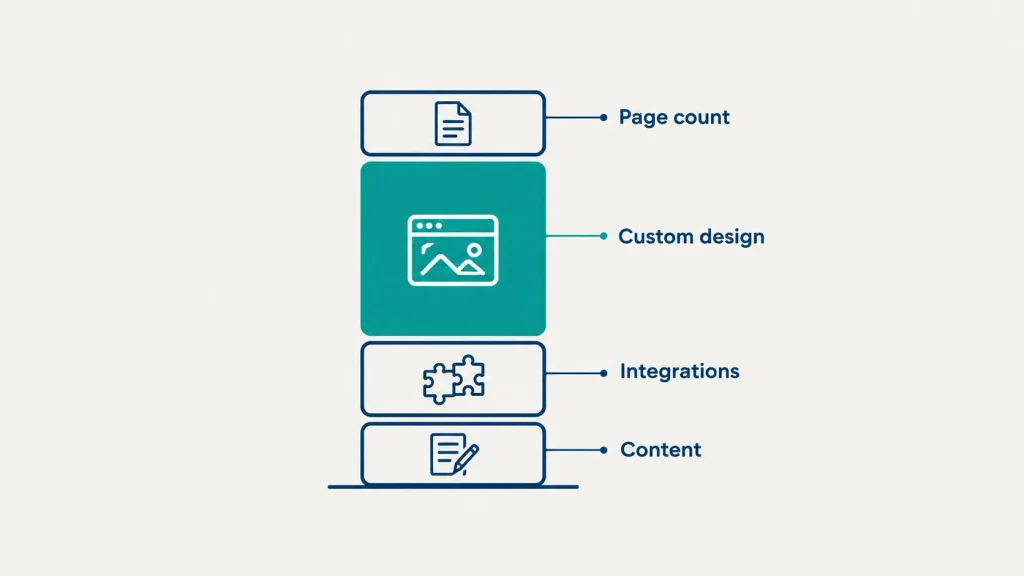
Six factors account for almost every difference between a $1,000 quote and a $10,000 one. Knowing them lets you compare quotes on the same terms.
- Number of pages. Every page needs design, content and testing. A 5-page site and a 25-page site are different projects.
- Template vs. custom design. A customized template is faster and cheaper. A fully custom design costs more but fits your brand and customer journey exactly.
- Features and integrations. Online booking, payments, live chat, CRM syncing and member logins each add development and testing time.
- Platform. WordPress keeps costs reasonable for most small businesses because of its huge plugin ecosystem, and experienced WordPress developers can extend it without rebuilding from scratch. Custom-coded sites cost more but suit unusual requirements.
- Mobile performance. Every site should work on phones, but responsive front-end builds that load fast on slower connections take more care than a template’s default settings.
- Content. Copywriting, professional photos and video are often priced separately. Supplying your own content lowers the bill but usually slows the timeline.
When two quotes look far apart, line them up against this list. The cheaper one often leaves out content, SEO setup or post-launch support rather than doing the same work for less.
Should You Use a DIY Builder, a Freelancer or an Agency?
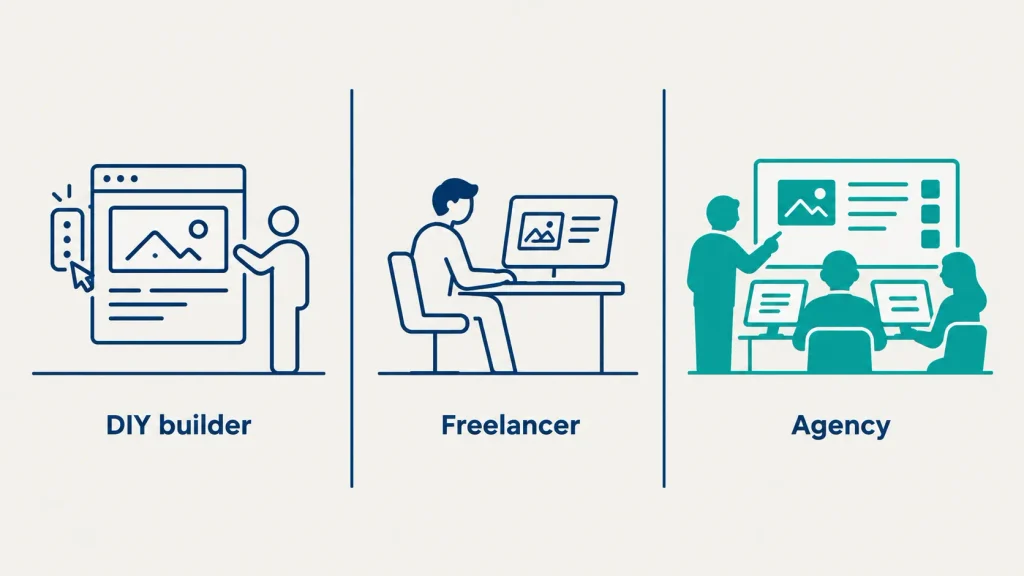
Each route can be the right one. The real question is how much of your own time you can put in and how much the site needs to grow with you.
| Option | Upfront cost | Your time | What you get | Watch out for |
| DIY website builder | $0 – $500, plus about $200 – $600/yr in plan fees | High: you design, write and maintain it | Fast, cheap launch with templates | Limited SEO control, design ceilings, platform lock-in |
| Freelancer | $1,000 – $6,000 | Medium | One person handling design and build | Availability for fixes later; who handles SEO and hosting |
| Agency | $3,000 – $15,000+ for custom work; some offer packaged plans from a few hundred dollars | Low to medium | Design, development, SEO and support from one team | Scope creep; make sure deliverables are listed in writing |
A DIY builder makes sense if your budget is under $500 and you have evenings to spare. A freelancer or agency makes more sense once the website needs to generate leads, because the hours you would spend learning design and SEO are hours away from running the business.
What Are the Ongoing Costs After Launch?
A website is not a one-time purchase. Most small businesses spend somewhere between $200 and $3,000 a year to keep a site live, secure and working, depending on how much support they want.
- Domain name: usually $10 to $25 a year.
- Hosting: roughly $60 to $600 a year, depending on speed and traffic.
- SSL certificate: free with most good hosts; paid certificates are rarely needed for small business sites.
- Updates and security: plugin, theme and core updates, backups and uptime checks. Many owners hand this to website maintenance services for $50 to $300 a month rather than risk a broken site.
- Content and SEO: optional but where growth comes from. Ongoing SEO typically starts around $500 a month for small local campaigns.
Speed is part of upkeep too. Google’s own research found that 53% of mobile visits are abandoned when a page takes longer than three seconds to load, so a site that slows down over time quietly costs you customers.
Where Do Small Businesses Overspend or Underspend?
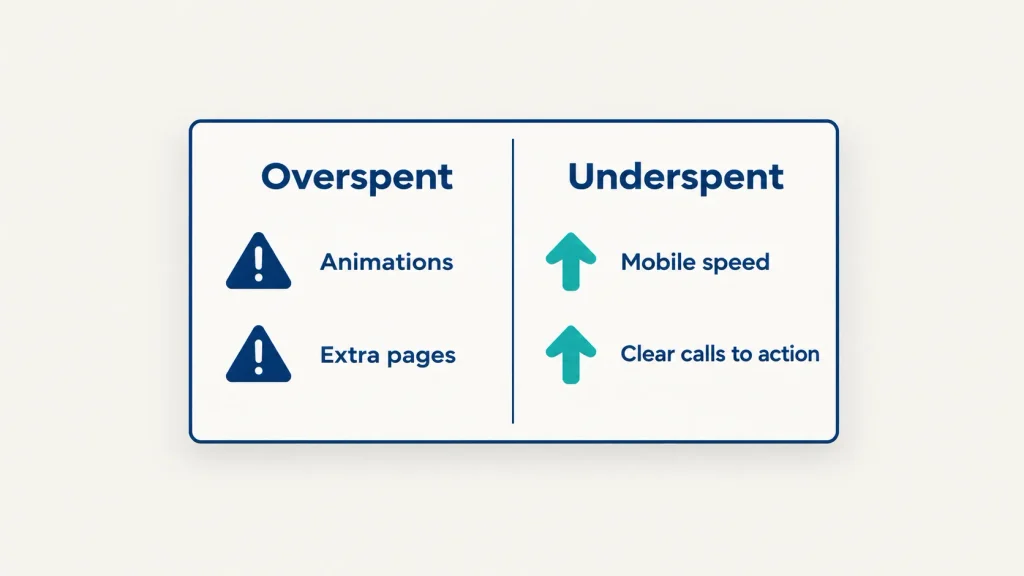
The most expensive website is often the cheap one that has to be rebuilt a year later. Stanford’s Web Credibility Research found that about 75% of people judge a company’s credibility by its website design, so the site is doing sales work whether you budget for it or not.
Common overspends:
- Paying for custom animations, extra pages or features nobody asked for.
- Buying a premium plan before you know which features you will actually use.
Common underspends:
- Skipping basic SEO setup. Without page titles, meta descriptions, fast load times and local and technical SEO foundations, a well-designed site can sit invisible on Google.
- Not owning your domain and hosting accounts. Make sure they are registered in your business name, not the builder’s.
- Launching with no maintenance plan, then paying more later to fix a hacked or broken site.
Which Website Budget Fits Your Business?
Match the budget to what the site needs to do in the next 12 to 18 months, not just on launch day.
- Just starting out or testing an idea: a one-page or starter site in the $400 to $1,500 range is enough. Focus on a clear offer, a phone number and a contact form.
- Established service business that needs leads: plan for $1,500 to $5,000, with on-page SEO and a conversion-focused layout built in from the start.
- Selling products online: budget from $3,000 for a straightforward store. Payment setup, product pages and checkout design are where ecommerce development costs go, and they are worth getting right.
At TruTransit Solutions, a web design and digital marketing agency working with startups and small businesses across the USA, pricing is packaged around those stages. The Starter plan ($399) covers a basic site or landing page with mobile-responsive design and basic SEO. The Growth plan ($599) adds full website design, branding basics, on-page SEO and a conversion-focused layout. The Premium plan ($999) adds advanced UI/UX, a full branding package, an SEO and social media strategy, and performance optimization. Custom features beyond those plans are quoted separately, so the scope is clear before work starts.
Frequently Asked Questions
Can I get a professional website for under $1,000?
Yes, if the scope is small. A one-page site or a short brochure site built on a solid template with mobile-responsive design and basic SEO can come in under $1,000. Custom design, extra pages and features like booking or payments will push the price higher.
How much should a small business budget per year to keep a website running?
Plan for about $200 to $3,000 a year. The low end covers domain, hosting and doing your own updates. The high end includes a professional maintenance plan, backups, security monitoring and small content changes.
Is WordPress cheaper than a custom-coded website?
For most small businesses, yes. WordPress has thousands of ready-made themes and plugins, so common features do not need to be built from scratch. A custom-coded site makes more sense when you need functionality WordPress cannot handle cleanly or performance requirements a plugin-heavy site will struggle to meet.
Do I own my website after I pay for it?
You should, but check the contract. Make sure the domain, hosting account and site files are in your business’s name and that you get admin access at handover. Some website builders and agencies license the site rather than transferring it, which makes leaving expensive later.
How long does it take to build a small business website?
Most small business websites take between 2 and 6 weeks. A landing page can be ready in one to two weeks, while a custom site or ecommerce store usually takes 4 to 10 weeks. The most common delay is waiting on content, such as copy, photos and product details, not the build itself.
The right website budget is the one that matches what the site needs to do for your business over the next year or two. Get quotes that list pages, features and ongoing costs in writing, and compare them line by line.
If you want a straight read on what your site should cost and which plan fits your goals, talk to our team for a free strategy call. No obligation, just a clear scope and a real number.