

Shopify vs WooCommerce: Which E-Commerce Platform Is Right for You?

Shopify is the better choice for businesses that want to launch quickly, prefer a managed platform with support included, and value ease of use over deep customization. WooCommerce is the better choice for businesses that want full control over their store, already run WordPress, need extensive customization, or want to avoid ongoing platform transaction fees. Shopify costs more per month but requires less technical maintenance. WooCommerce has lower platform costs but shifts hosting, security, and update responsibility onto you or your development team.
Both platforms power hundreds of thousands of working online stores. Neither is objectively better. They make different trade-offs, and the right choice depends on what you value more: managed simplicity or customization control.
This comparison covers cost, ease of use, design flexibility, SEO capability, scalability, and long-term maintenance. If you are at the platform decision stage of an e-commerce project, this is one of the choices that shapes everything downstream.
What Is the Core Difference Between Shopify and WooCommerce?
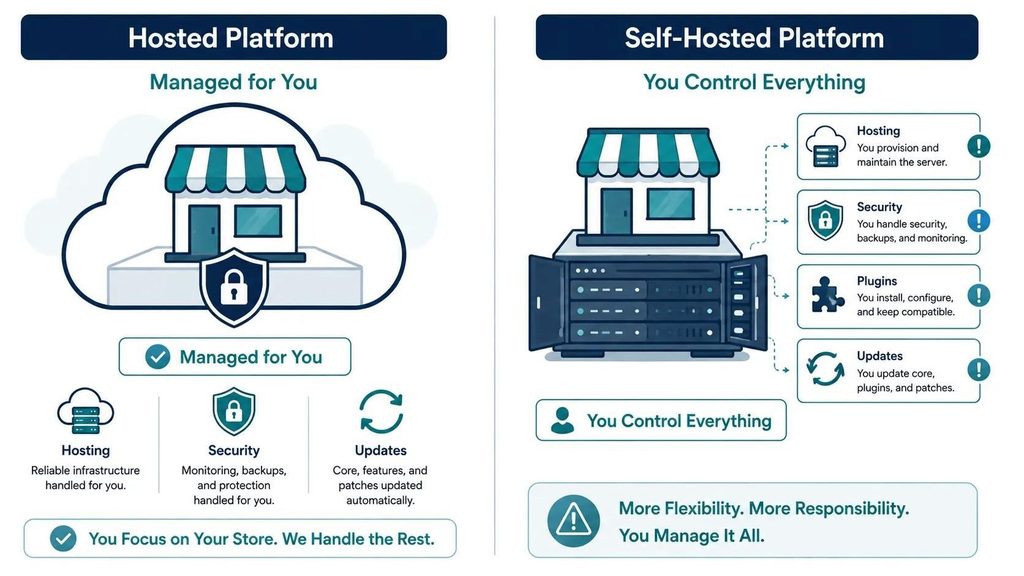
Shopify is a hosted, all-in-one commerce platform. You pay a monthly fee and Shopify handles hosting, security, updates, PCI compliance, and uptime. You build your store within their system.
WooCommerce is a free plugin that turns a WordPress site into an online store. You provide your own hosting, manage your own security and updates, and have complete control over how the site is built. The plugin is free; everything around it has costs.
| Shopify | WooCommerce | |
|---|---|---|
| Type | Hosted SaaS platform | Self-hosted WordPress plugin |
| Who manages hosting | Shopify | You or your hosting provider |
| Who handles security and updates | Shopify | You or your development team |
| Base cost | $39-$399/mo depending on plan | Plugin free; hosting $25-$150/mo |
| Transaction fees | 0.5-2% unless using Shopify Payments | None from WooCommerce; only your payment processor’s fees |
| Setup speed | Fast; store live in days | Slower; requires WordPress setup and configuration |
| Customization ceiling | Moderate; limited by Shopify’s architecture | Very high; full code access |
How Do the Real Costs Compare?
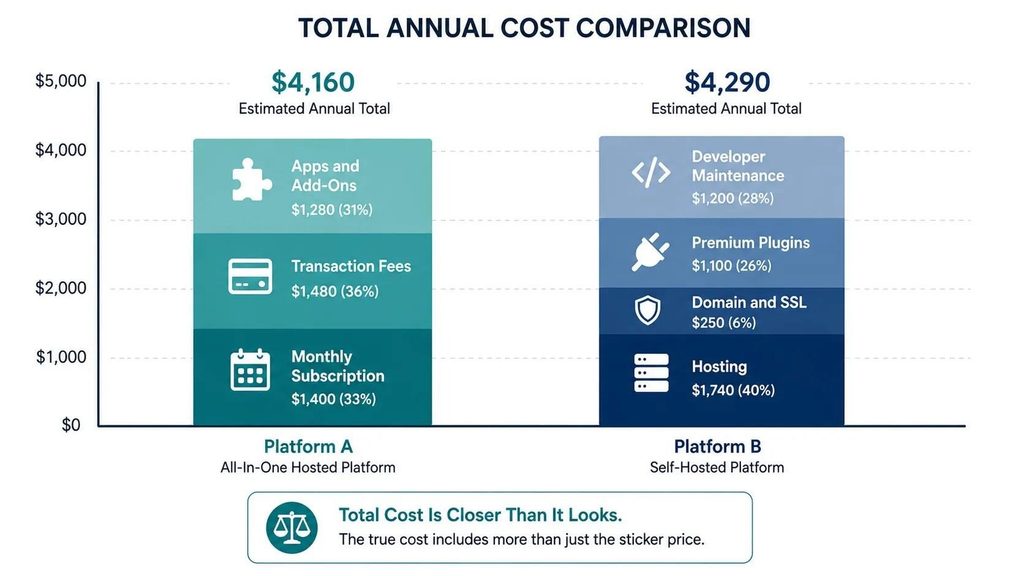
Headline pricing is misleading for both platforms. The real cost depends on which apps or plugins you need and how much development work the store requires.
| Cost Category | Shopify | WooCommerce |
|---|---|---|
| Platform fee | $39/mo (Basic) to $399/mo (Advanced) | $0 for the plugin itself |
| Hosting | Included | $25-$150/mo for quality managed WordPress hosting |
| SSL certificate | Included | Usually included with hosting |
| Payment processing | 2.9% + $0.30 typical with Shopify Payments | 2.9% + $0.30 typical with Stripe or PayPal |
| Extra transaction fee | 0.5-2% if using an external gateway | None |
| Apps / plugins | $0-$300+/mo depending on needs | $0-$500/year for premium plugins (often one-time or annual) |
| Theme | $0-$400 one-time | $0-$100 one-time typical |
| Realistic monthly total | $80-$500/mo | $50-$300/mo plus periodic maintenance |
The pattern most stores experience: Shopify costs more in predictable monthly fees. WooCommerce costs less monthly but requires either your own time or paid developer time for maintenance, updates, and troubleshooting. Whether WooCommerce is genuinely cheaper depends on how you value that time.
Which Platform Is Easier to Use?
Shopify, clearly, for non-technical users. The admin interface is designed for people who are running a business rather than managing a website. Adding products, processing orders, updating inventory, and configuring shipping all happen through a clean interface with no technical knowledge required.
WooCommerce requires familiarity with WordPress. Product management is straightforward once you know the system, but the surrounding responsibilities (plugin updates, backups, security monitoring, resolving plugin conflicts) require either technical comfort or an ongoing relationship with a web development team who handles it.
For a business owner who wants to manage the store themselves without technical support, Shopify removes a category of problems that WooCommerce introduces.
Which Platform Offers More Design Flexibility?
WooCommerce, by a significant margin. Because it runs on WordPress with full code access, there is essentially no design limitation beyond what a developer can build. Custom layouts, unique product page structures, and bespoke functionality are all achievable.
Shopify offers strong templates and reasonable customization within its Liquid templating system, but there are architectural boundaries. Certain checkout customizations, for example, are restricted on lower-tier plans and only fully available on Shopify Plus.
For most stores, Shopify’s design flexibility is more than sufficient. The stores that hit Shopify’s ceiling tend to be those with unusual product configurations, complex custom pricing logic, or highly specific UI/UX requirements that do not fit standard e-commerce patterns.
Which Platform Is Better for SEO?
WooCommerce has a structural advantage, primarily because it runs on WordPress, which offers deeper control over technical SEO elements.
| SEO Factor | Shopify | WooCommerce |
|---|---|---|
| URL structure control | Limited; forced /products/ and /collections/ paths | Full control over permalink structure |
| Meta tag management | Good; built-in fields for title and description | Excellent with Yoast or Rank Math plugin |
| Schema markup | Basic product schema built in; apps for more | Full control via plugins or custom code |
| Content marketing capability | Blog included but limited compared to WordPress | WordPress is the strongest content platform available |
| Page speed control | Limited; Shopify manages infrastructure | Full control but requires active optimization |
| Technical SEO fixes | Constrained by platform architecture | Any fix is possible with developer access |
In practice, both platforms can rank well. Shopify’s constraints rarely prevent a store from ranking; they just limit fine-grained optimization at the margins. WooCommerce’s advantage is most meaningful for stores where content marketing is a primary traffic strategy, since WordPress remains the strongest platform for that. Either way, a proper SEO strategy matters more than the platform choice itself.
Which Platform Scales Better as Your Store Grows?
Both scale, but differently.
Shopify scales through plan upgrades. As order volume grows, you move to higher tiers and eventually Shopify Plus for enterprise volume. The infrastructure scaling is handled entirely by Shopify, which is a genuine advantage during high-traffic periods like sales events.
WooCommerce scales through infrastructure investment. Growing stores need better hosting, caching layers, database optimization, and often a CDN. This gives you control over the scaling approach but requires technical management. A WooCommerce store with 10,000 products on inadequate hosting will perform poorly; the same store on properly configured infrastructure performs excellently.
The practical threshold: stores processing under a few hundred orders per day work fine on either platform with reasonable setup. Above that, the infrastructure decisions become more consequential and benefit from experienced technical guidance.
Which Should You Choose for Your Business?
| Your Situation | Recommended Platform | Reason |
|---|---|---|
| You want to launch fast with minimal technical involvement | Shopify | Managed hosting, security, and support included |
| You already run a WordPress site with content | WooCommerce | Integrates directly with existing site and content |
| Content marketing is central to your traffic strategy | WooCommerce | WordPress is the strongest content platform |
| You need unusual custom functionality or pricing logic | WooCommerce | Full code access removes platform constraints |
| You have no technical resource and want support included | Shopify | 24/7 support and managed infrastructure |
| You want to minimize ongoing platform fees | WooCommerce | No monthly platform fee or extra transaction charges |
| You expect high-traffic sales events | Shopify | Infrastructure scaling handled automatically |
| You want full ownership of your platform and data | WooCommerce | Self-hosted; you own the entire stack |
Frequently Asked Questions
Can I migrate from Shopify to WooCommerce or vice versa later?
Yes, and migrations in both directions are common. Product data, customer records, and order history can be exported and imported using migration tools or plugins. The parts that do not transfer cleanly are design and custom functionality, which need to be rebuilt on the new platform. Budget for a migration to cost roughly 40-70% of a fresh store build, depending on catalog size and how much custom work existed on the original store. URL structure changes also require a careful redirect plan to preserve SEO value.
Is WooCommerce really free?
The plugin is free. Running a WooCommerce store is not. You pay for hosting, a domain, likely a premium theme, often several premium plugins for functionality that Shopify includes by default (advanced shipping rules, subscriptions, bookings), and either your own time or paid support for maintenance. A realistic WooCommerce store costs $50-$300 per month to operate, which is often less than Shopify but not free.
Which platform has better payment processing options?
Both support all major payment processors. Shopify strongly incentivizes using Shopify Payments by charging an additional 0.5-2% transaction fee if you use an external gateway like Stripe or PayPal directly. WooCommerce has no such penalty; you use whichever processor you prefer at that processor’s standard rates. For stores with high transaction volume, this difference can be financially meaningful over a year.
Does Shopify or WooCommerce handle security better?
Shopify handles it for you: PCI compliance, SSL, server security, and platform patching are all managed. With WooCommerce, security is your responsibility, which means keeping WordPress core, themes, and all plugins updated, using quality hosting with security monitoring, and maintaining backups. A well-maintained WooCommerce store is secure. A neglected one is a genuine risk, and neglect is common because updates require active attention.
Which platform works better for a store that also has a mobile app?
Both offer APIs that allow a mobile app to connect to your store data. Shopify’s Storefront API is well-documented and widely used for headless commerce implementations. WooCommerce offers a REST API that is equally capable, though it may require more configuration. For a business planning both a web store and a native shopping app, either platform can serve as the commerce backend, and the decision should be made on the web store criteria rather than the app consideration.
Shopify and WooCommerce solve the same problem with opposite philosophies. Shopify trades control for convenience. WooCommerce trades convenience for control.
If you value your time more than your platform fees and want to focus on selling rather than managing a website, Shopify is the practical choice. If you want full ownership, deep customization, and lower ongoing platform costs, and you have technical support available, WooCommerce is the stronger fit.
If you want a platform recommendation based on your specific catalog, budget, and technical situation, talk to TruTransit Solutions. We build on both platforms and will recommend the one that fits your business, not the one that makes the project bigger.
2 Responses
This site has quickly become my go to for weekend gaming sessions. The registration process was simple and I got my account verified in no time. I really like the community chat feature and the transparent rules on all promotions. krkrclud
Thank you for sharing your experience! We’re glad to hear you appreciate the easy-to-use interface and clear information. We value your feedback and appreciate you taking the time to comment on our blog!