
React Native vs Flutter in 2026: Which Is Right for Your Business?

React Native is the stronger choice for teams already working in JavaScript, products that need deep third-party library support, and businesses where developer hiring is a near-term concern. Flutter is the better pick for pixel-perfect custom UI, apps targeting performance-sensitive use cases, and teams starting fresh without an existing JavaScript codebase. Both are production-ready in 2026. The choice is almost never about which framework is objectively better — it is about which fits your team, your timeline, and your product requirements.
This comparison gets debated endlessly in development forums, usually by people who have a preferred answer going in. The reality in 2026 is that both React Native and Flutter are mature, well-supported frameworks capable of shipping production-quality apps. Neither is going away.
The useful question is not which is better in the abstract. It is which is better for your specific project, team, and business constraints. That is what this guide works through.
If you are at the stage of choosing a framework, you are likely already thinking about mobile app development seriously. The framework decision is one input into a broader set of choices around team, scope, and platform.
What Are React Native and Flutter, and How Do They Differ?
Both are cross-platform frameworks, meaning they let you write one codebase that runs on iOS and Android. That is where the similarity ends at the architecture level.
| React Native | Flutter | |
|---|---|---|
| Created by | Meta (Facebook), open source since 2015 | Google, open source since 2018 |
| Language | JavaScript (TypeScript supported) | Dart (Google-developed language) |
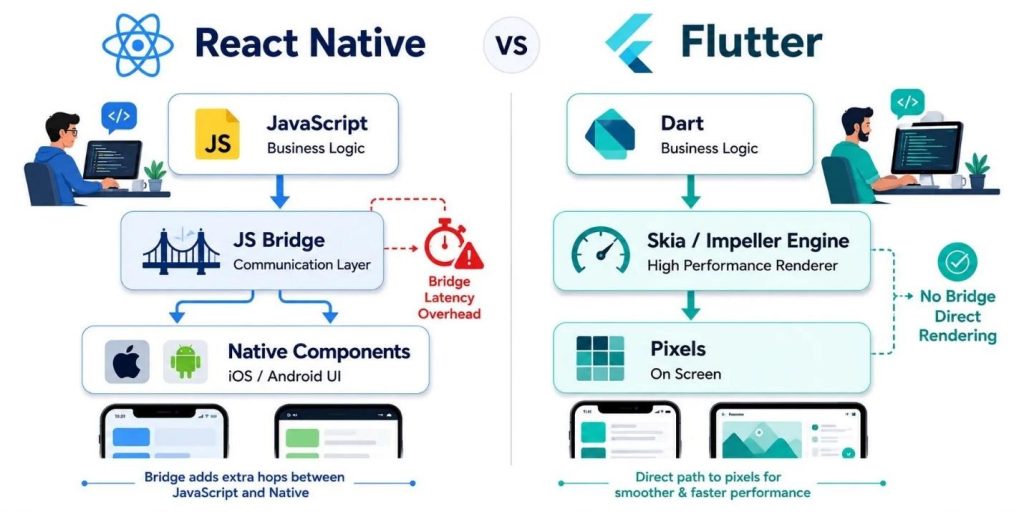
| Rendering approach | Uses native platform components via a JavaScript bridge (or JSI in newer versions) | Draws its own UI using the Skia / Impeller graphics engine — bypasses native components |
| UI philosophy | Renders platform-native components; feels native on each OS | Renders identically on all platforms using its own engine |
| Maturity | 9+ years in production; battle-tested at scale | 6+ years; rapidly matured; now widely used in production |
| Community size | Larger developer community; more Stack Overflow coverage | Smaller but fast-growing; strong official documentation |
| GitHub stars (2026) | ~118,000+ | ~165,000+ |
| Major apps using it | Meta, Shopify, Discord, Walmart | Google Pay, Alibaba (Xianyu), BMW, eBay Motors |
Flutter has overtaken React Native in GitHub stars and is growing faster in new project adoption. React Native maintains a larger existing talent pool and a more established third-party library ecosystem. Both of those facts are relevant depending on your situation.
How Does Performance Compare Between React Native and Flutter?
Performance is the most frequently cited argument in this debate. The honest picture is more nuanced than “one is faster.”
Where Flutter Has a Performance Edge
Flutter’s rendering engine draws UI components directly using its own graphics layer (Impeller in Flutter 3.x). Nothing goes through the native UI toolkit, which eliminates a category of performance overhead that exists in React Native’s bridge architecture.
For animation-heavy interfaces, complex custom UI components, and apps with high frame-rate requirements (games, data visualizations, media players), Flutter consistently delivers smoother results with less optimization effort.
Where React Native Has Caught Up
React Native’s New Architecture, which became the default in 2024, replaced the old JavaScript bridge with JSI (JavaScript Interface) and introduced concurrent rendering. For standard app UI with lists, navigation, and form-heavy screens, the performance gap between the two frameworks is narrow enough to be irrelevant in practice.
The apps where React Native’s architecture still creates friction are those with very high-frequency native module calls, heavy animations running at 120fps, or complex gesture-driven interactions that require tight synchronization between JavaScript and native threads.
What Does This Mean for Your Decision?
If your app’s core experience is content-heavy (feeds, lists, forms, navigation), performance is not a meaningful differentiator between the two. If your app depends on high frame-rate animation, complex gesture recognition, or pixel-precise custom UI as a core feature, Flutter is the lower-risk choice for hitting those targets.
Which Framework Is Easier to Staff and Hire For?
This is the most underrated factor in the framework decision, and it is the one that bites teams hardest after they have already committed.
React Native Hiring
React Native uses JavaScript and TypeScript, the most widely known languages in web development. If your team already has JavaScript engineers, they can contribute to a React Native codebase with relatively low ramp-up time. The talent pool is larger, the interview process is more familiar, and junior developers are easier to find.
The trade-off is that JavaScript knowledge does not automatically translate to strong React Native knowledge. Native module debugging, performance profiling, and platform-specific behavior still require mobile-specific experience. Hiring a “JavaScript developer” is not the same as hiring a React Native developer.
Flutter Hiring
Flutter uses Dart, which most developers do not know before picking up Flutter. The initial hiring hurdle is higher because you are looking for either a Flutter specialist or a developer willing to learn Dart. The good news is that Dart is straightforward to learn for anyone with experience in typed languages like TypeScript, Kotlin, or Swift. Most strong Flutter developers learned Dart as part of learning Flutter.
The Flutter talent pool is smaller but growing quickly. Contractors and agencies specializing in Flutter are now common, and the community produces high-quality learning resources. For a project where you are hiring an agency rather than building an in-house team, Flutter availability is less of a constraint.
The In-House vs Agency Question
If you are building an in-house mobile team over time, React Native’s larger talent pool is a genuine practical advantage. If you are engaging a mobile development agency for the build, both frameworks are readily available and the talent pool difference matters less than the agency’s actual experience with the framework they recommend.
Which Framework Has the Better Library and Ecosystem Support?
Third-party library availability matters most when your app needs to integrate with external services, hardware, or platform-specific functionality.
React Native’s Ecosystem Advantage
React Native’s nine-year head start means the npm ecosystem is dense with battle-tested packages for common integration needs: analytics (Amplitude, Mixpanel), payments (Stripe React Native), maps (React Native Maps), camera, biometrics, and background tasks. Products like e-commerce apps benefit especially from this depth, since payment and inventory integrations have well-maintained React Native packages with large communities behind them.
The risk is package maintenance. The React Native ecosystem has a well-documented problem with packages becoming unmaintained as contributors move on. Depending on a library that is no longer actively maintained is a real project risk, particularly for security-sensitive integrations.
Flutter’s Ecosystem in 2026
Flutter’s pub.dev package repository has grown significantly since 2020. Most common integration needs now have first-party or well-maintained third-party packages. Google ships first-party Flutter packages for Firebase, Google Maps, in-app purchases, and several hardware APIs, which are consistently maintained and well-documented.
Where Flutter’s ecosystem still lags is in niche or enterprise integrations. If your app needs to connect with a legacy enterprise system, a specialized hardware SDK, or an industry-specific API, the React Native package may exist and the Flutter equivalent may require you to write a native plugin yourself. That adds cost and time.
Platform-Specific Features
Both frameworks support native modules when you need platform-specific functionality that the framework does not abstract. The implementation process is similar: write native code in Swift/Objective-C (iOS) or Kotlin/Java (Android) and expose it to the framework. Flutter calls this a platform channel. React Native calls it a native module. The effort level is comparable.
Which Framework Gives Designers More Control Over the UI?
The two frameworks take fundamentally different approaches to UI rendering, and that difference matters depending on your design requirements.
Flutter: Pixel-Perfect by Default
Because Flutter draws every pixel using its own engine, what you design is what every user sees, on every device, on both platforms. There is no platform-specific rendering behavior to account for. Animations, custom components, and brand-specific UI elements look identical on a Pixel phone and an iPhone.
This makes Flutter a strong fit for products where visual precision and brand consistency are core to the experience. If your UI/UX design is a genuine differentiator and you cannot afford iOS and Android looking slightly different, Flutter removes that variable.
React Native: Platform-Native Look and Feel
React Native renders using native platform components where possible. That means a button, a list, or a navigation bar looks the way the platform expects it to look. For many business apps, this is actually the right call: users are already familiar with platform conventions, and a native feel reduces learning curve.
The downside is that highly custom designs require more work to implement consistently across platforms. A design system with custom components that deviate significantly from platform conventions will take more development time in React Native than in Flutter.
React Native vs Flutter: Which Should You Choose by Use Case?
Neither framework wins in every scenario. Here is a practical decision matrix for the most common situations.
| Your Situation | Better Choice | Reason |
|---|---|---|
| Team already knows JavaScript/TypeScript | React Native | Lower ramp-up; existing knowledge transfers directly |
| Building for maximum animation and visual precision | Flutter | Skia/Impeller rendering gives consistent pixel-perfect output |
| Need to hire developers quickly from a large talent pool | React Native | More JavaScript developers available; lower hiring bar |
| Starting fresh with no framework preference | Flutter | Faster hot reload, better tooling consistency, growing ecosystem |
| App needs deep third-party library integrations | React Native | Larger npm ecosystem; more production-tested packages |
| App is design-system-first with custom UI throughout | Flutter | One rendering engine means one set of design rules |
| Building a content feed, form-heavy, or CRUD-style app | Either | Performance gap is negligible; team preference decides |
| Targeting global markets with diverse Android devices | Flutter | Custom renderer avoids Android fragmentation rendering quirks |
| Existing React or React Native codebase to extend | React Native | Code sharing and architecture consistency |
| Agency build where team chooses the stack | Ask the agency | Use the framework they have the most production hours in |
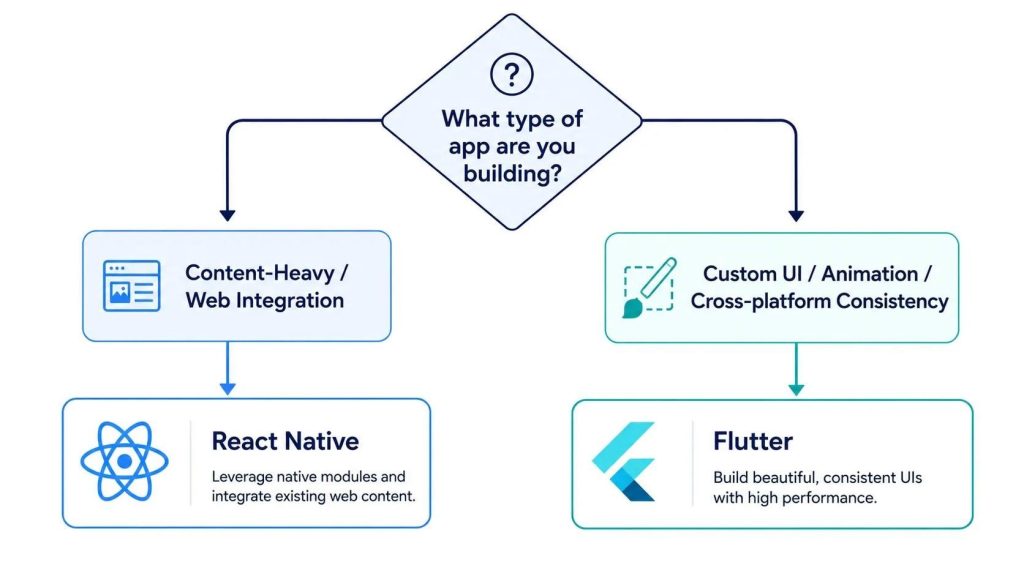
The last row is worth dwelling on. If you are hiring an agency to build your app, the most important question is not which framework is theoretically better. It is which framework the agency has shipped production apps in. A Flutter-native team will deliver a better Flutter app than a React Native team asked to use Flutter for the first time, and vice versa.
Does the Framework Choice Affect Development Cost?
Directly, in a few ways.
Talent Cost
React Native developers are generally slightly less expensive to hire than Flutter specialists at the same experience level, because the supply is larger. The difference narrows as Flutter adoption grows and should not be the deciding factor in your framework choice.
Development Speed
Flutter’s hot reload and widget-based architecture often produce faster UI iteration cycles than React Native for custom designs. If your product has heavy UI work, Flutter may actually reduce total development hours. React Native’s larger library ecosystem means less time writing integrations from scratch for standard features. For teams evaluating whether they need a native app or a high-performance web application instead, framework speed matters differently depending on which direction the product is heading.
Long-Term Maintenance
Both frameworks receive regular updates. React Native’s New Architecture migration required significant refactoring for many existing apps in 2023-2024. Flutter has maintained strong backward compatibility through its major releases. For a new build starting in 2026, both are stable starting points. If your mobile app development timeline extends to ongoing product development over several years, Flutter’s stricter versioning and Google’s first-party maintenance of core packages reduces long-term maintenance risk slightly.
Frequently Asked Questions
Is Flutter replacing React Native?
Not in any definitive way. Flutter has grown faster in recent years and has more GitHub stars, but React Native maintains a larger existing install base and a much larger talent pool. Both frameworks are actively maintained and both have large companies backing them. The more accurate framing is that Flutter has become a genuine equal to React Native rather than a secondary option, which is where things stood in 2019-2021.
Can React Native and Flutter share code with web apps?
React Native shares the JavaScript/TypeScript language with web React apps, but not the component library. React Native for Web exists as a project that allows some code sharing, but it is not a seamless experience. Flutter also has Flutter for Web, which lets you compile a Flutter app to run in a browser, though performance and browser compatibility require careful management. Neither framework is a true write-once-run-everywhere solution across native mobile and web.
Which framework is better for an MVP?
For a fast MVP, both are viable. Flutter’s development speed for UI-heavy products is a practical advantage when iterating quickly on design. React Native’s larger library ecosystem means you spend less time building integrations from scratch. The real answer is whichever your development team knows best, because familiarity is the biggest speed variable in an MVP timeline.
What is the learning curve for Dart compared to JavaScript?
Dart is a statically typed, object-oriented language. Developers with TypeScript, Java, Kotlin, or Swift experience pick it up in one to four weeks. Developers coming only from dynamic JavaScript (no TypeScript) face a steeper adjustment to typed syntax and class-based structure. Google’s official Dart and Flutter documentation is thorough and well-maintained, which shortens the learning curve compared to many framework migrations.
Does the framework choice affect App Store approval?
No. Apple and Google do not care which framework you used. Apps built in React Native, Flutter, native Swift/Kotlin, or any other framework go through the same App Store review process against the same guidelines. What matters for app store approval is app behavior, privacy policy compliance, content guidelines, and technical performance, none of which is framework-specific.
In 2026, the React Native vs Flutter decision is not the high-stakes coin flip it was in 2020. Both frameworks are production-ready. Both have strong backing. Both can deliver a high-quality cross-platform app.
The decision comes down to your team’s existing skills, your product’s specific UI requirements, the integrations you need, and whether you are building in-house or with an external team. Get those four inputs right and the framework choice follows naturally.
If you are weighing these options for a specific project and want a technical perspective grounded in what actually gets shipped, talk to the team at TruTransit Solutions. We work in both frameworks and will recommend the one that fits your project, not the one that fits our preference.