

On-Demand App Development: How to Build the Next Uber or DoorDash

On-demand app development means building a two-sided marketplace app that connects service providers (drivers, couriers, freelancers) with customers in real time, typically including GPS tracking, in-app payments, and a matching algorithm. These apps cost $60,000-$200,000+ to build, depending on complexity, and require three connected components: a customer app, a provider app, and an admin dashboard. The hardest parts are not the individual features but making real-time tracking, payment splitting, and matching logic work reliably at scale.
Every founder pitching an on-demand app references Uber or DoorDash at some point. The comparison is useful for explaining the concept but misleading about the difficulty. These companies operate at a scale and with engineering resources most startups will never need to match. What you actually need to build is a working version of the same core mechanics at a scope that fits your specific market.
This guide breaks down what an on-demand app actually requires, what it costs, and how to scope a realistic first version. If you are early in planning this kind of mobile app development project, the architecture decisions covered here shape your entire budget.
What Makes an App ‘On-Demand’ and Why Is It More Complex Than a Standard App?
An on-demand app connects two distinct user groups, providers and customers, in real time around a service that needs to happen now or soon. This structure, called a two-sided marketplace, introduces complexity that a standard single-user app does not have.
The core complexity comes from needing three separate, interconnected applications working together:
- Customer app: Where the service is requested, tracked, and paid for
- Provider app: Where the driver, courier, or service provider receives requests, navigates, and gets paid
- Admin dashboard: Where the business manages the marketplace: provider onboarding, dispute resolution, analytics, and payment reconciliation
Each of these has its own user experience requirements, and they all need to communicate with each other in real time. A delay or bug in this communication directly disrupts the core service experience.
What Are the Core Features an On-Demand App Needs?
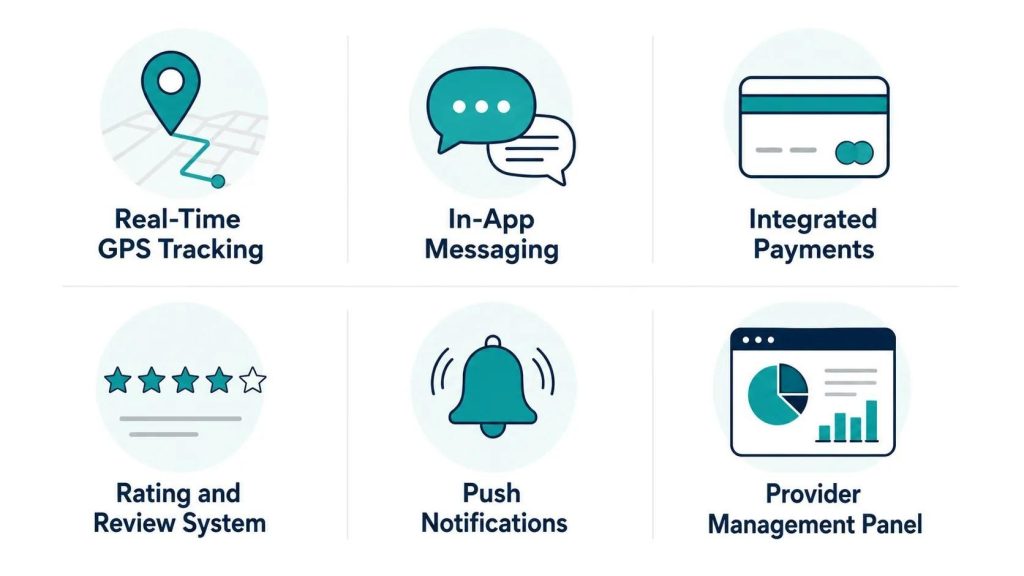
| Feature | Customer App | Provider App | Complexity Driver |
|---|---|---|---|
| Real-time GPS tracking | See provider location and ETA | Navigate to customer/pickup location | Requires constant location updates and battery-efficient background tracking |
| Matching algorithm | Get matched to nearest available provider | Receive and accept/decline requests | Logic must balance proximity, availability, and fairness across providers |
| In-app payments | Pay automatically on completion | Receive payout after service | Requires split payments, holding funds, and payout scheduling |
| Push notifications | Status updates on request progress | New request alerts | Must be instant and reliable; delayed notifications break the experience |
| Ratings and reviews | Rate the provider after service | Rate the customer after service | Two-way rating systems need moderation and dispute handling |
| In-app messaging or calling | Contact provider directly | Contact customer directly | Often uses masked numbers for privacy and safety |
| Order/request history | View past services and receipts | View past completed jobs and earnings | Standard but needs to scale with usage volume |
Beyond these core features, most on-demand apps also need surge or dynamic pricing logic, provider background check integration, and cancellation policy enforcement. The UI/UX design challenge is significant too: both apps need interfaces simple enough to use one-handed, often while walking or driving, with minimal cognitive load during time-sensitive moments.
How Much Does It Cost to Build an On-Demand App?
| Build Approach | Estimated Cost | Timeline | Notes |
|---|---|---|---|
| White-label / template solution | $15,000-$40,000 | 2-3 months | Faster and cheaper but limited customization; many providers share the same base |
| Custom MVP, single platform, cross-platform framework | $40,000-$80,000 | 4-6 months | Custom branding and logic; covers core features only; one platform initially |
| Custom MVP, both platforms, cross-platform framework | $60,000-$120,000 | 5-8 months | Full feature set for both customer and provider apps on iOS and Android |
| Full custom build, native, both platforms | $120,000-$250,000+ | 8-14 months | Maximum performance and customization; appropriate for well-funded ventures |
| Enterprise-scale platform | $250,000-$500,000+ | 12-20+ months | High-volume, multi-market platforms with advanced algorithms and infrastructure |
These figures do not include the admin dashboard, which typically adds $15,000-$40,000 depending on complexity, or ongoing infrastructure costs (servers, mapping API fees, SMS/push notification services), which scale with usage. A realistic total first-year investment, including digital marketing for launch, generally starts around $80,000-$150,000 for a focused, single-market MVP.
What Should Your MVP Actually Include?
The mistake most founders make is trying to build a full-featured platform before validating that the core service works in their specific market. A focused MVP proves the model with less investment and faster learning.
A realistic on-demand MVP includes:
- Customer app: request a service, see provider location and ETA, pay automatically, rate after completion
- Provider app: receive and accept requests, navigate to customer, mark service complete, see earnings
- Basic admin dashboard: view active requests, manage provider accounts, see basic transaction data
- Manual matching as a fallback: for very early-stage launches in a single small market, manual dispatch by a human operator is sometimes more practical than a fully automated matching algorithm
What to defer to version 2: surge pricing, advanced analytics, loyalty programs, in-app chat, multi-language support, and scheduled (versus on-demand only) bookings. These add real value but are not necessary to validate whether the core service model works for your market.
What Technical Decisions Matter Most for an On-Demand App?
Mapping and Location Services
Google Maps Platform and Mapbox are the two dominant choices for the mapping, geocoding, and routing functionality these apps depend on. Google Maps offers more comprehensive global coverage; Mapbox often costs less at scale and offers more design customization. Both charge per API call, and costs scale meaningfully with usage, which is worth modeling before committing to either.
Real-Time Communication Architecture
Live location tracking and instant request notifications require a real-time communication layer, typically built with WebSockets or a managed service like Firebase Realtime Database or Pusher. This is one of the more technically demanding parts of the build and benefits significantly from a development team with specific prior experience building this kind of system.
Payment Processing and Split Payments
Standard payment processors like Stripe support split payments through Stripe Connect, which is built specifically for marketplace platforms that need to collect payment from one party and pay out to another, minus a platform fee. This is more complex than standard e-commerce payment processing and should be scoped specifically rather than assumed to work the same way.
Cross-Platform vs Native for This App Type
On-demand apps benefit significantly from cross-platform development given the need to launch both a customer app and a provider app simultaneously on both iOS and Android. The real-time location tracking and notification requirements work well within React Native or Flutter for the vast majority of on-demand use cases, with native modules used selectively where deeper hardware integration is genuinely needed.
What Are the Biggest Risks in Building an On-Demand App?
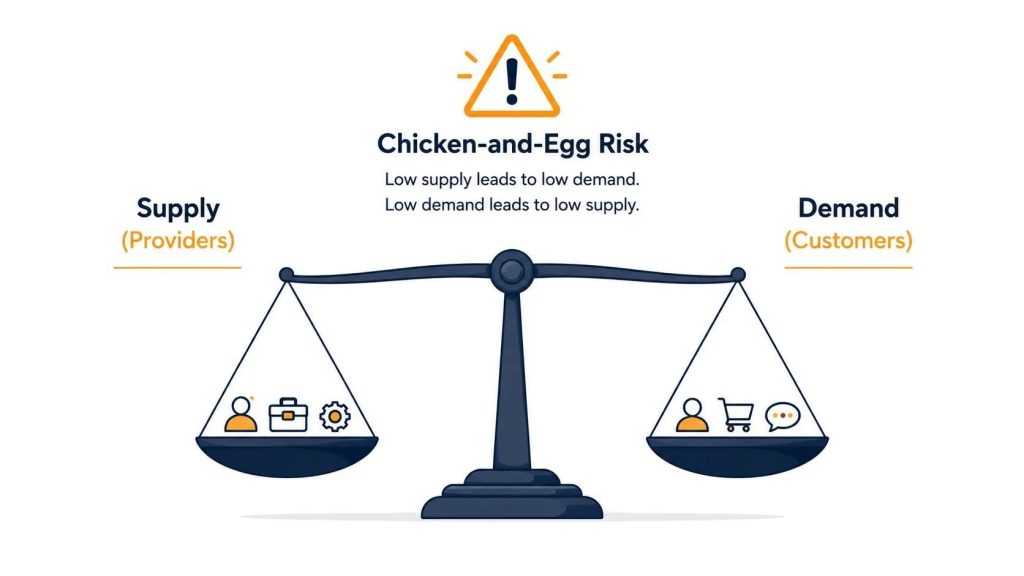
| Risk | Why It Matters | How to Mitigate It |
|---|---|---|
| Chicken-and-egg marketplace problem | Need providers to attract customers and customers to attract providers | Launch in one small, focused geographic area first; manually recruit initial providers |
| Underestimating real-time infrastructure complexity | Live tracking and notifications are harder to build reliably than they appear | Work with a team with direct prior experience in this specific app category |
| Regulatory and insurance requirements | Many on-demand categories (transportation, food delivery, home services) have local licensing requirements | Research local regulations for your specific category before development, not after |
| Underpricing the true cost of provider acquisition | Providers often need incentives to join an unproven platform | Budget for provider incentives separately from app development costs |
| Payment compliance and fraud | Marketplaces are common fraud targets | Use established payment infrastructure (Stripe Connect) rather than building custom payment logic |
Frequently Asked Questions
Can I use a white-label solution instead of building a custom app?
Yes, and for many early-stage on-demand businesses this is a sensible starting point. White-label platforms provide a pre-built app you can brand and configure for your specific service category at a fraction of custom development cost. The trade-off is limited differentiation and constraints on custom features. If your business model depends on a unique mechanic that sets you apart from competitors, a custom build is usually necessary. If your differentiation is market focus or service quality rather than app functionality, a white-label solution can validate the business faster and cheaper.
How do on-demand apps make money?
The most common models are: a commission on each transaction (typically 15-30% of the service price, similar to Uber and DoorDash), a subscription fee for providers to access the platform, a per-transaction service fee charged to customers, or a hybrid combining several of these. The right model depends on your specific market and what your providers and customers will tolerate. Researching what comparable platforms in your category charge is a useful starting benchmark.
How many providers do I need before launching?
There is no universal number, but the practical goal is enough provider coverage that a customer request gets fulfilled quickly and reliably in your launch area. For a single-neighborhood or small-city launch, this might be as few as 10-20 active providers. Launching with too few providers creates a poor first experience for early customers, which is difficult to recover from. Many successful on-demand businesses started by manually recruiting and onboarding their first provider cohort before any app existed.
Do I need a lawyer involved in building an on-demand app?
Strongly recommended, particularly around provider classification (independent contractor versus employee, which varies significantly by jurisdiction and has been the subject of major legal disputes for companies like Uber and DoorDash), local licensing requirements for your service category, and your terms of service and liability framework. These are not app development questions, but they directly affect how the app needs to be built and what data and consent flows it needs to capture.
What is the realistic timeline from idea to launch for an on-demand app MVP?
A focused MVP, built with a cross-platform framework and a development team experienced in this app category, typically takes 5-8 months from initial discovery to a working launch in your first market. This includes the customer app, provider app, basic admin dashboard, and a soft launch period for testing with real users before a full public launch. Rushing this timeline significantly increases the risk of a buggy launch in a category where reliability directly affects whether users trust the platform.
Building an on-demand app is a genuinely harder engineering and product challenge than most standard business apps, primarily because of the real-time, two-sided coordination required. That difficulty is also why the category has produced some of the most valuable companies built in the last 15 years.
Start with a focused MVP in one market, prove the core mechanics work reliably, and expand from a position of validated demand rather than trying to build the full platform before you know if anyone wants it.
If you are scoping an on-demand app idea, talk to TruTransit Solutions. We have worked through the real-time tracking, matching, and payment architecture challenges this category requires and can give you a realistic scope and budget for your specific concept.
4 Responses
[200983]supplies professional anti-violence equipments and solutions for the whole world with strong and perfect production capacity. anti-violence.org
Thank you for sharing your comment! We appreciate your visit to our blog and your interest in sharing information about your products and services. Thanks for stopping by!
Greetings mates I have been spinning over here regularly and the game selection just keeps getting better every month. Everything runs smoothly even during peak hours and the customer care team is always ready to help with a smile. Swing by and claim your starter bonus now kkslotmalaysia
Thank you for sharing your thoughts! We appreciate your feedback and are glad to hear you value a smooth experience and helpful customer support. Thanks for stopping by and being part of our community!