
Mobile App Development Cost in 2026: What to Budget for iOS and Android

Mobile app development in 2026 costs between $8,000 and $300,000+ depending on the type of app, the platform, and the team you work with. A simple single-platform app with basic features runs $8,000-$30,000. A mid-complexity app with backend integration, user accounts, and cross-platform support costs $30,000-$100,000. Enterprise-grade apps with custom logic, real-time features, and third-party integrations start at $100,000 and go well beyond that.
The most common mistake business owners make when budgeting for an app is treating it like a website. A website is a set of pages. An app is a product with logic, data, user states, and behavior that changes in real time. Those are different builds with different cost structures.
The second most common mistake is asking “how much does an app cost?” without defining what the app does. That question is like asking how much a car costs without specifying whether you want a city runabout or a commercial truck. The answer is meaningless without scope.
This guide gives you a breakdown by app type, platform, and feature set so you can go into a mobile app development conversation with a realistic number in mind, not a number someone gave you to win the meeting.
How Much Does Mobile App Development Cost by App Type?
App type is the single biggest driver of cost. Here are realistic 2026 ranges for the most common categories, based on a professional development team building a production-ready product.
| App Type | Single Platform | Cross-Platform | What Drives the Range |
|---|---|---|---|
| Simple informational or brochure app | $8,000-$15,000 | $12,000-$20,000 | Number of screens, CMS integration, push notifications |
| Booking or appointment app | $20,000-$45,000 | $30,000-$60,000 | Calendar logic, payment setup, notification system, admin panel |
| E-commerce app | $30,000-$70,000 | $45,000-$90,000 | Product catalog, cart, checkout, payment gateway, inventory sync |
| Social or community app | $40,000-$90,000 | $55,000-$120,000 | User profiles, feeds, messaging, notifications, content moderation |
| On-demand service app (Uber-style) | $60,000-$150,000 | $80,000-$200,000 | Real-time tracking, two-sided marketplace, payment splits, driver/rider logic |
| Healthcare or telemedicine app | $50,000-$150,000 | $70,000-$180,000 | HIPAA compliance, video consult, EHR integration, data security |
| Fintech or banking app | $80,000-$250,000 | $100,000-$300,000+ | Regulatory compliance, bank API integration, fraud detection, encryption |
| Enterprise or SaaS app | $100,000-$300,000+ | $120,000-$350,000+ | Custom backend, multi-role access, integrations, scalability requirements |
These ranges assume a full build from scoping to app store submission. They do not include ongoing maintenance, server costs, or future feature development. Those are real ongoing costs that need to be part of the budget conversation.
Does It Cost More to Build for iOS, Android, or Both?
Platform choice is one of the first decisions you make, and it affects both cost and timeline. Here is how the three paths compare.
iOS Only (Swift / SwiftUI)
Building natively for iOS means targeting iPhone and iPad users. The Apple ecosystem is more controlled, which simplifies testing but limits your reach to Apple device users. iOS-only builds are typically 10-20% cheaper than Android-only due to fewer device fragmentation issues during testing.
iOS users in the US tend to have higher average household incomes and higher in-app purchase rates, which makes iOS a strong first choice for consumer apps targeting a US market with a premium product.
Android Only (Kotlin / Java)
Android holds a larger global market share, making it the better choice for international markets or budget-conscious consumer segments. Android testing is more complex because of device fragmentation: hundreds of different screen sizes, OS versions, and manufacturer customizations need to be accounted for. That adds testing time and cost relative to iOS.
Cross-Platform (React Native / Flutter)
Cross-platform frameworks like React Native and Flutter let a single codebase run on both iOS and Android. The cost saving compared to building two native apps is real: typically 30-50% lower than two separate native builds. The trade-off is that highly performance-intensive features or platform-specific UI patterns can require native code bridges that partially close the cost gap. For most business apps, cross-platform development is the right call on both cost and reach.
| Platform | Relative Cost | Reach | Best For |
|---|---|---|---|
| iOS Native | Moderate | Apple device users only | US consumer apps, premium products, App Store monetization |
| Android Native | Moderate (higher testing cost) | Global majority market share | International markets, budget segments, Android-first enterprises |
| Cross-Platform (RN/Flutter) | Lower (one codebase) | iOS and Android | Most business apps, startups validating ideas, budget-conscious builds |
| Both Native (separate builds) | Highest | Full iOS and Android | Apps where platform-specific UX is critical and budget allows |
What Do Specific App Features Cost to Build?
Feature scope is where most app budgets drift. A client adds “just one more thing” at three different meetings and the budget has moved by $40,000 before anyone noticed. These estimates give you a sense of what individual features add to a project.
| Feature | Estimated Add-On Cost | Notes |
|---|---|---|
| User authentication (email/password) | $1,500-$3,000 | Social login (Google, Apple) adds $1,000-$2,000 per provider |
| Push notifications | $2,000-$5,000 | Segmented or scheduled notifications add complexity |
| In-app payments (Stripe, Apple Pay) | $3,000-$8,000 | Subscription billing logic adds $3,000-$6,000 on top |
| Real-time chat or messaging | $8,000-$20,000 | Depends on media sharing, read receipts, group chat requirements |
| GPS / location tracking | $5,000-$15,000 | Real-time multi-user tracking (like Uber) sits at the high end |
| Third-party API integration | $2,000-$8,000 per API | Cost depends on API documentation quality and data complexity |
| Admin dashboard / CMS | $5,000-$15,000 | More user roles and reporting features push this higher |
| Offline functionality | $4,000-$10,000 | Data sync logic on reconnect adds significant complexity |
| AI or ML features | $10,000-$50,000+ | Depends on model complexity, training data, and inference requirements |
| Multi-language support | $3,000-$8,000 | Per language after the first; RTL languages add layout work |
The honest takeaway: a feature list is not a budget. You need to prioritize. What does the app need to do on day one to be useful? What can be added in version 2? An experienced development team will help you make those calls, but you should go into the conversation with a clear must-have versus nice-to-have list already drafted.
How Does the Development Team Affect the Cost?
The same app can cost very different amounts depending on who builds it. Team structure, location, and experience level all affect the final number.
| Team Type | Typical Rate | Pros | Cons |
|---|---|---|---|
| Freelancer (offshore) | $15-$40/hr | Lowest hourly rate | Quality variance, communication risk, limited accountability |
| Freelancer (US-based) | $75-$150/hr | Cultural alignment, strong communication | Limited capacity, single point of failure |
| Offshore agency | $25-$60/hr | Team coverage, project management included | Time zone gaps, variable quality control |
| US-based boutique agency | $100-$175/hr | High quality, reliable process, local accountability | Higher cost; projects typically $30,000 minimum |
| Large enterprise agency | $150-$300/hr | Deep resources, enterprise experience | High overhead built into rate; not suited for early-stage builds |
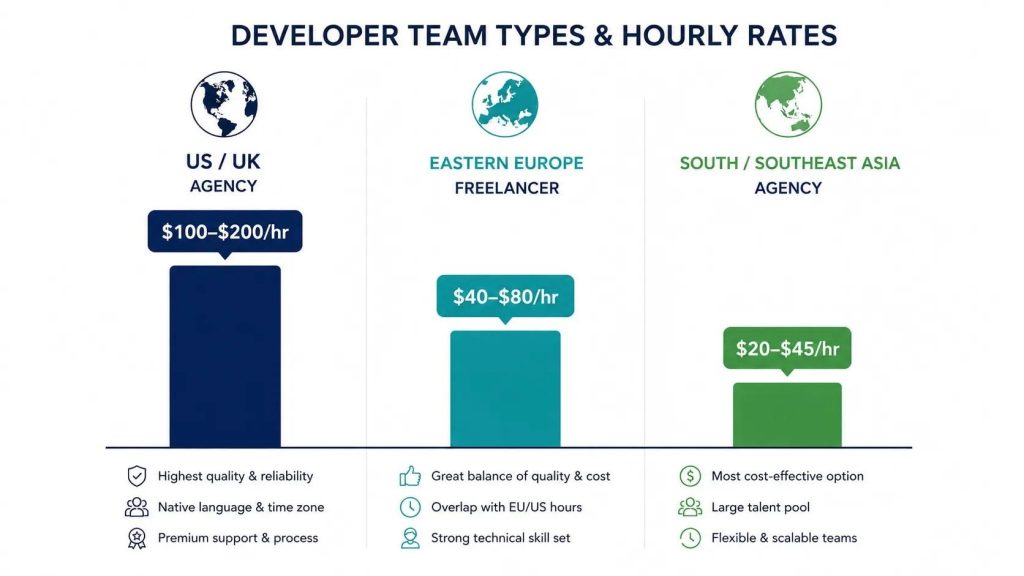
Rate alone is not the right metric. A $30/hr offshore team that misses requirements and delivers a product that needs significant rework costs more than a $120/hr US team that scopes accurately and ships clean code. Ask for references. Ask to see code quality or architecture decisions. Ask what their QA process looks like.
At TruTransit Solutions, a digital development agency based in Wood Dale, IL, we scope mobile projects with a fixed discovery phase before any development starts. The reason is simple: the most expensive mistake in app development is building the wrong thing. A clear spec before coding starts is not overhead. It is what keeps the budget honest. You can see how we approach mobile app projects on our services page.
What Are the Hidden Costs of Mobile App Development?
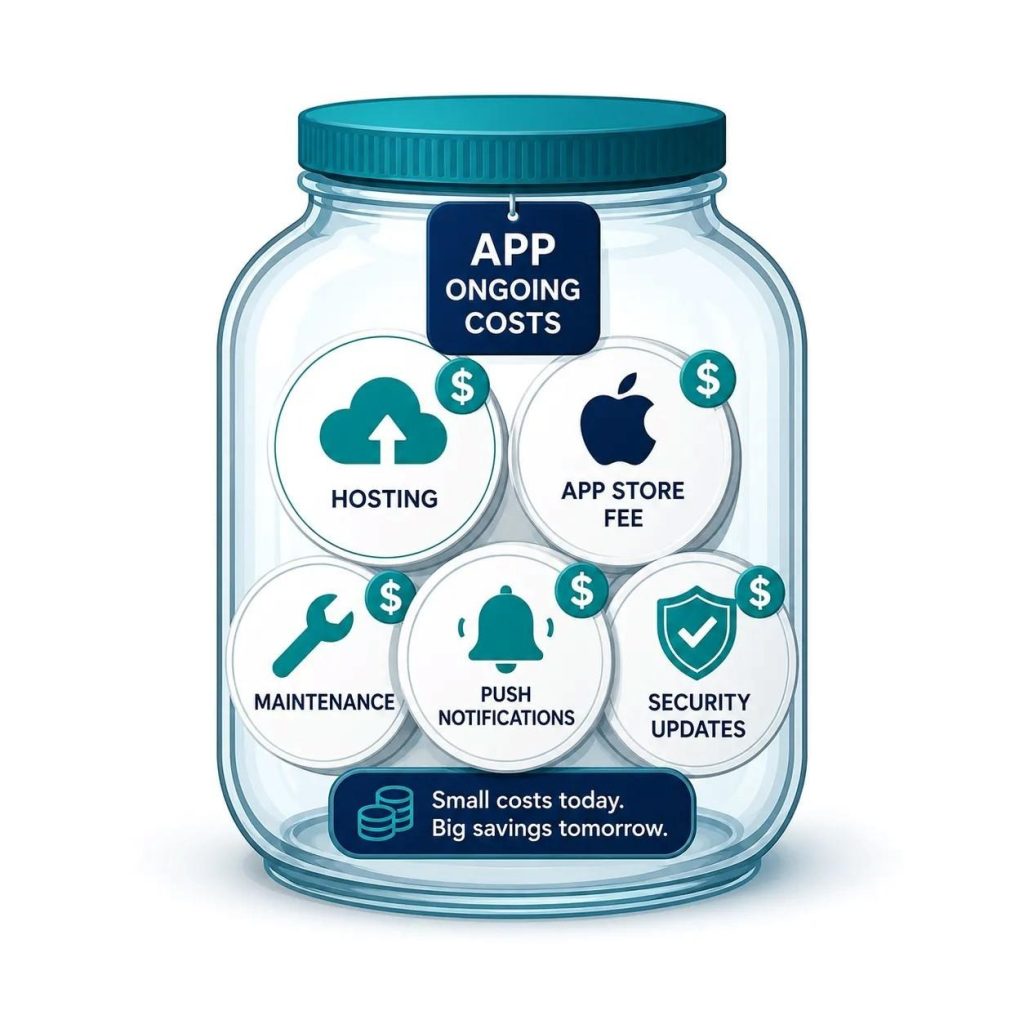
The build cost is the most visible number. It is rarely the total cost. Here is what businesses routinely underestimate.
App Store Fees
- Apple App Store: $99/year developer account. Apple takes 15-30% of in-app purchase revenue
- Google Play Store: $25 one-time registration. Google takes 15-30% of in-app purchase revenue
- Review time: Apple reviews take 1-3 days on average. Rejections require fixes and resubmission, adding time to your launch
Backend and Server Infrastructure
Every app that stores data, handles user accounts, or processes transactions needs a backend server. This is a separate cost from the app itself. Depending on your architecture, expect $50-$500 per month in cloud infrastructure costs (AWS, Google Cloud, Firebase) at launch, scaling with user growth.
Ongoing Maintenance
iOS and Android release major OS updates annually. Apps that are not updated to stay compatible break on new OS versions. Budget 15-20% of the original build cost per year for maintenance, bug fixes, and OS compatibility updates. This is not optional if you want the app to keep working.
Marketing and User Acquisition
Building the app is half the work. Getting users to find and download it is the other half. App Store Optimization (ASO), paid installs, and digital marketing for an app launch are costs that often come as a surprise. A realistic user acquisition budget for a new consumer app is $5,000-$20,000 in the first three months, depending on your target audience and competitive category.
UI/UX Design
If your development quote does not include a dedicated UI/UX design phase, budget separately for it. A proper design process (wireframing, prototyping, user testing) for a mid-complexity app runs $8,000-$25,000. Skipping this phase and designing as you develop almost always produces a product that needs a redesign in version 2.
How Do You Get an Accurate App Development Quote?
Vague quotes come from vague briefs. The more specific you are when approaching a developer or agency, the more accurate the estimate you get back.
What to prepare before your first development conversation:
- A clear problem statement: What does the app solve, for whom, and why does that person need an app rather than a website?
- User flow sketches: Even rough paper sketches of the key screens and how a user moves through the core journey help scope the work dramatically
- A prioritized feature list: Separate must-haves (version 1) from nice-to-haves (version 2). This alone prevents significant scope and budget drift
- Platform decision: iOS, Android, or both? If unsure, ask the developer which makes more sense for your target user demographic
- Backend requirements: Will the app need user accounts, data storage, or third-party API connections? List all integrations you know about upfront
- Comparable apps: Three to five existing apps with features you want to replicate. This is the fastest way to communicate scope without writing a 20-page spec document
A well-scoped brief gets you a quote that reflects your actual project. A vague brief gets you a quote designed to win the meeting, with costs added back in via change orders once work starts. If you want to build something closer to a web experience than a full native product, it is worth comparing web development options alongside app development to find the right fit for your goals.
Frequently Asked Questions
Can I build an app for under $10,000?
For a simple single-platform app with limited features and no backend complexity, $8,000-$15,000 is achievable with the right development team. Below $8,000, you are looking at heavily templated builds, no-code platforms, or offshore work at the lower end of quality assurance. No-code tools like Bubble, Adalo, or Glide can produce functional apps for $3,000-$6,000, but they have real ceiling limitations on performance, scalability, and custom functionality.
Is it cheaper to build an app or a website?
A website is almost always cheaper. A professional small business website costs $3,000-$10,000 versus $15,000-$100,000+ for a comparable mobile app. Apps require native development for two platforms, app store submission and compliance, OS compatibility maintenance, and often a separate backend. If a responsive website serves your use case, it is the more cost-effective starting point. An app makes more sense when the use case requires camera access, offline functionality, push notifications, or a deeply mobile-native experience.
How much does it cost to maintain a mobile app per year?
Budget 15-20% of the original build cost annually for maintenance. A $50,000 app costs approximately $7,500-$10,000 per year to keep current across OS updates, security patches, third-party API changes, and minor bug fixes. Server infrastructure adds $600-$6,000 per year depending on your user base and backend complexity. Feature development is billed separately on top of maintenance.
What is the cheapest way to build an app in 2026?
The lowest-cost paths are no-code platforms (Bubble, Adalo, Glide) for simple apps, cross-platform development with React Native or Flutter for production-quality builds, or offshore development teams for budget-constrained projects. Each trade-off is real: no-code limits scalability, offshore work requires careful vetting and clear specs, and cross-platform has edge cases where native performance is better. The cheapest option that meets your actual requirements is the right choice, not the cheapest option available.
How long does it take to build a mobile app?
A simple app takes 2-4 months. A mid-complexity app with backend, payments, and user accounts takes 4-7 months. Complex apps with real-time features, compliance requirements, or large data systems take 8-18 months. These timelines include discovery, design, development, testing, and app store review. The most common causes of delay are late design decisions, incomplete specs at the start, and scope additions mid-project.
App development budgets go wrong in two directions. Some businesses underestimate the cost and get partway through a build before the money runs out. Others overbuild for what they actually need and spend six figures on features their users never adopt.
The fix for both is the same: a clear scope and a realistic conversation before any code is written. Know what the app needs to do in version 1. Know which features can wait. And know the total cost of ownership, not just the build cost, before you commit.
If you are working out the scope and budget for a mobile app, talk to the team at TruTransit Solutions. We scope mobile projects with a fixed discovery phase so the quote you receive reflects the actual project, not a number revised upward once work starts.