How Much Does Logo Design Cost in 2026? What to Expect and What to Avoid
Logo design in 2026 costs between $50 and $5,000+ depending on who does the work and what the deliverables include. AI logo generators and template tools run $0-$50. Freelance platforms like Fiverr produce logos in the $50-$300 range. Experienced independent designers charge $300-$1,500. A branding agency with a full process delivers at $1,500-$5,000+. The price differences reflect the thinking behind the design, not just the visual output. A cheap logo that does not scale, does not differentiate, or cannot be reproduced consistently costs more over time than a properly designed one.
Every business needs a logo. Not every logo is worth what was paid for it.
The logo design market in 2026 runs from free AI generators to agency engagements that cost as much as a small website. What you get at each price point varies dramatically, and the difference is not always obvious from looking at the finished file.
This guide breaks down the realistic cost ranges, what each one delivers, and what to look for when evaluating options. If logo design is part of a broader branding project, the context for each investment level changes. Covered below.
What Are the Main Logo Design Price Ranges in 2026?
There are five meaningful price tiers in the logo design market. Each reflects a different level of process, expertise, and deliverable quality.
| Price Range | Who Does the Work | What You Get | Right For |
|---|---|---|---|
| $0-$50 | AI tools (Looka, Canva, Wix Logo Maker) | Template-based mark; limited uniqueness; basic file formats | Testing a concept; temporary placeholder only |
| $50-$300 | Budget freelancers (Fiverr, 99designs contests) | Custom-looking design; variable quality; often limited revisions | Very early stage; tight budget; low brand visibility needs |
| $300-$800 | Experienced freelancers; mid-tier platforms | Considered design; proper file formats; 2-3 revision rounds | Small businesses with moderate brand presence |
| $800-$1,500 | Senior freelancers; boutique designers | Brand-informed process; multiple concepts; full file suite; usage guidelines | Growing businesses where brand consistency matters |
| $1,500-$5,000+ | Branding agencies; full identity studios | Discovery + strategy + design + brand guidelines + asset system | Businesses building a scalable brand from the ground up |
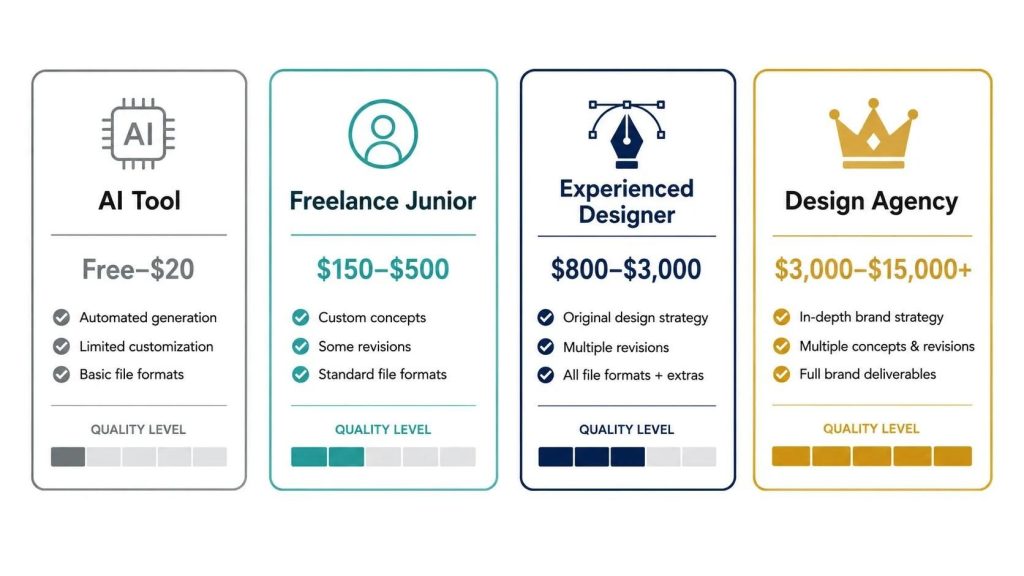
These ranges assume the US market. Offshore freelancers charge less at every tier. The trade-off is communication overhead, revision cycles that stretch timelines, and occasionally deliverables that require significant rework before the files are usable.
What Does a Professional Logo Design Actually Include?
A logo is a file. A professional logo design is a process that produces that file along with everything needed to use it correctly across different applications.
At the $800+ level, a logo design engagement should include:
- Discovery brief: Questions about the business, audience, competitors, and brand personality that inform the design direction before any sketching starts
- Multiple initial concepts: Typically 2-4 distinct directions presented at the first review, not one finished logo to approve or reject
- Revision rounds: At least 2 structured rounds of revisions after concept selection; unlimited revision processes produce worse results, not better ones
- Full file suite: SVG (vector, scalable to any size), PNG (transparent background), JPG, PDF; color and monochrome versions; dark and light background variants
- Color palette: Primary brand colors with hex, RGB, and CMYK values so the logo reproduces consistently in print and on screen
- Typography guidance: The fonts used in or alongside the logo, with licensing information
- Usage guidelines: Clear notes on minimum sizes, spacing rules, background restrictions, and what not to do with the mark
What separates a $200 logo from an $800 one is usually not the visual complexity. It is the deliverable completeness and the process rigor. A logo delivered as a low-resolution PNG with no vector file is a logo you cannot use in print, on signage, or at large scale without remaking it.
What Are the Hidden Costs of Cheap Logo Design?
The upfront price is not the total cost. Cheap logo design creates downstream expenses that are easy to underestimate.
Remaking Files for Different Applications
A logo delivered as a JPEG or low-resolution PNG cannot be scaled for a billboard, a vehicle wrap, or embroidery without visible quality loss. Recreating a logo in vector format from a raster file costs $100-$400 depending on complexity. Businesses that buy a cheap logo and then need professional signage often discover this expense at the worst possible time.
Trademark Conflicts
AI generators and template platforms produce marks that may be similar to logos already in use by other businesses. A logo that cannot be trademarked because it is too similar to an existing registered mark creates legal and rebranding exposure. Custom designed logos go through at least a basic similarity check during the design process. Template marks do not.
Rebranding Costs
A logo that does not work at small sizes, does not read in monochrome, or does not represent the business accurately as it grows requires a rebrand earlier than it should. Rebrands cost more than original brand design because they also require updating all existing touchpoints: website, social profiles, printed materials, signage, uniforms, packaging.
The businesses that rebrand most quickly after a budget logo purchase are usually those that grew faster than they expected and found their brand could not keep up. If growth is the goal, investing in a brand identity that scales from the start is more cost-effective than two rounds of design work.
What Is the Difference Between a Logo and a Brand Identity?
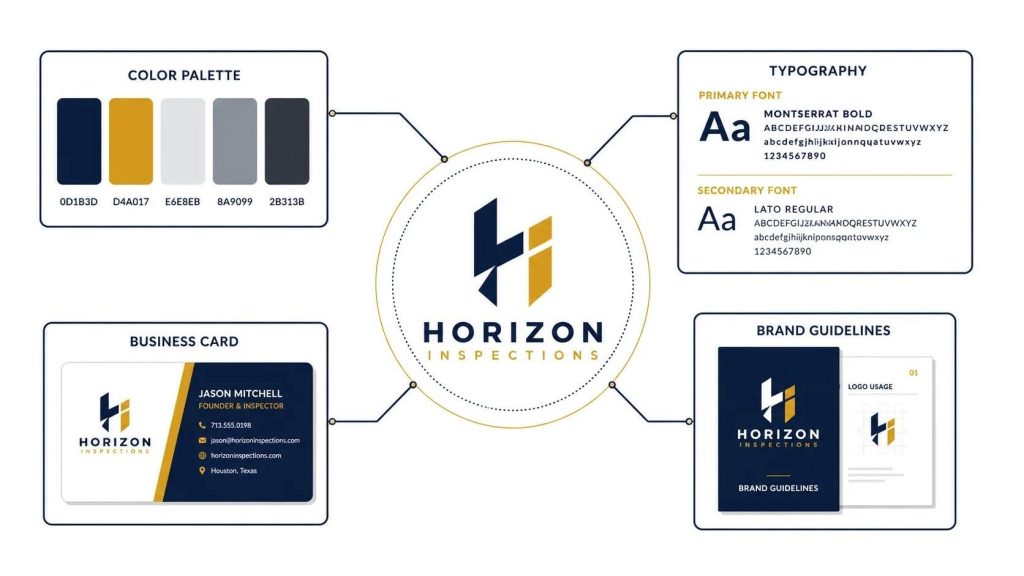
A logo is a mark: a graphic element that represents a business. A brand identity is the complete visual system: the logo, color palette, typography, photography style, iconography, and the rules for how all of those elements work together.
| Deliverable | What It Covers | Typical Cost Range |
|---|---|---|
| Logo only | Single mark in multiple formats and colors | $300-$2,000 |
| Logo + color palette + typography | Core visual identity elements | $800-$3,000 |
| Brand identity system | Full guidelines document covering all visual applications | $2,000-$8,000 |
| Brand identity + website design | Identity applied to web design and UI components | $5,000-$20,000+ |
| Full brand strategy + identity | Positioning, messaging, naming, visual identity, guidelines | $10,000-$50,000+ |
For most small businesses, the practical starting point is a logo with color palette and typography guidance. That combination covers the most common use cases: website, social media, business cards, and printed materials. A web design project that follows brand development benefits significantly from having these elements decided before the website design starts. Designers working with brand-defined colors and fonts produce more consistent, faster results.
Should You Use an AI Logo Generator?
For a placeholder while you validate a business idea, yes. For a business you intend to grow, no.
AI logo generators work from templates and combine elements algorithmically. The output can look polished at first glance. The problems surface when you try to trademark it (often not possible due to similarity to existing marks), reproduce it in print (usually not delivered as a true vector), or use it alongside other businesses that generated a similar mark from the same tool.
The more visible your business becomes, the more its brand identity matters. A logo that was adequate for a social media profile becomes a liability when it appears on a vehicle, a storefront, or a trade show booth next to professionally branded competitors. And as your digital marketing presence grows, your logo is the first visual a new customer associates with your name across every channel.
If you are in early validation mode with no revenue and no customers yet, an AI generator is a reasonable temporary tool. Once the business has traction, commissioning a proper custom logo and brand identity is the right move before the brand becomes established enough that changing it creates friction.
What Questions Should You Ask a Logo Designer Before Hiring?
Four questions surface most of the issues that make logo projects go wrong:
- What file formats will I receive, and do they include vector files (SVG or EPS)? If the answer is only PNG or JPG, keep looking.
- Do you retain any rights to the design after I pay? Some designers retain copyright on spec-work or contest designs. You want full ownership of the final mark.
- How many concepts will I see, and how many revision rounds are included? One concept with one revision round is a risk. Two to four concepts with two revision rounds is a reasonable process.
- Do you do any research into my industry or competitors before starting? A designer who starts with a blank canvas without context is guessing at what will work for your business.
These questions apply whether you are hiring through a freelance platform, a local designer, or a digital agency. The answers tell you more about the quality of the engagement than the portfolio does.
Frequently Asked Questions
How long does logo design take?
At the budget end, 1-3 days. At the $800-$1,500 range with a proper process, 1-3 weeks including discovery, concept presentation, revisions, and final file delivery. Full brand identity projects at the $3,000+ level typically run 3-6 weeks. The biggest variable is client feedback turnaround time: designers working with clients who review quickly and give specific, actionable feedback consistently deliver faster and better results.
Can I trademark a logo I bought on Fiverr or from an AI tool?
Possibly, but with risk. Fiverr logos designed from scratch by a designer who signs over rights can be trademarked if they pass the distinctiveness test and are not confusingly similar to existing marks. AI-generated logos face additional hurdles: the US Patent and Trademark Office has taken the position that AI-generated works without sufficient human creative input may not qualify for copyright protection, which affects trademark eligibility. For a logo you intend to protect, commission original work and get a written assignment of rights.
What file format should my logo be delivered in?
The essential formats are: SVG or EPS (vector, scalable infinitely without quality loss), PNG with transparent background (for web and digital use), and PDF (for print vendors). If a designer delivers only a JPEG, that file cannot be used for professional print work or scaled to large sizes. Always ask for vector files before accepting final delivery. If the designer cannot provide them, the logo was not built properly.
Does a logo need to look good in black and white?
Yes. Fax, embroidery, single-color printing, newspaper advertising, rubber stamps, and engraving all reproduce in monochrome. A logo that only works in full color is a logo that fails in a significant range of real-world applications. Testing the mark in black and white is a basic quality check that a professional designer runs as part of the process. If yours does not pass it, the design has a structural problem.
Is it worth paying more for a logo from an agency versus a freelancer?
Sometimes. The difference at the agency level is usually not the visual output on its own. It is the strategic context: the agency asks deeper questions about positioning, competitive differentiation, and how the brand needs to evolve. For a business at early stage, that strategic layer may be premature. For a business preparing to scale, enter a new market, or attract investment, the strategic grounding of an agency brand engagement produces a result the freelancer process typically does not.
A logo is not just a graphic. It is the visual shorthand for everything your business represents. The businesses that treat it as an administrative checkbox to complete cheaply and quickly tend to revisit the decision sooner than they expected.
Get the file formats right. Get ownership of the files in writing. And make sure whoever designs it has asked enough questions about your business to make a considered decision about what it should communicate.
If you are ready to invest in a logo or a complete brand identity, get in touch with TruTransit Solutions. We approach brand projects with a discovery process before any design starts, and we deliver the full file suite you need to use the mark across every application.