
Local SEO for Small Businesses: A Step-by-Step Guide to More Customers

Local SEO is the process of optimizing your online presence so your business appears when nearby customers search for what you offer on Google. The most important steps are: claim and fully complete your Google Business Profile, ensure your business name, address, and phone number are consistent across all online directories, gather genuine customer reviews, build location-relevant pages on your website, and publish content that connects your services to your city or service area. Local SEO results can appear in 4-8 weeks for less competitive markets.
When someone searches ‘plumber near me’ or ‘best pizza in Wood Dale,’ Google serves a local pack: a map with three business listings above the organic results. Getting your business into that map pack is what local SEO is about.
The businesses that appear there consistently are not doing anything mysterious. They have a complete and active Google Business Profile, consistent information across the web, and a pattern of genuine customer reviews. Here is how to build all three.
What Is Local SEO and How Is It Different from Regular SEO?
Regular SEO focuses on ranking in standard Google search results for informational or commercial queries. Local SEO focuses specifically on appearing in Google’s local results: the map pack, the local finder, and organic results with local intent.
| Regular SEO | Local SEO | |
|---|---|---|
| Goal | Rank for topic-based searches nationally or globally | Rank for location-based searches in your city or service area |
| Primary signal | Content quality, backlinks, domain authority | Google Business Profile completeness, reviews, local citations, proximity |
| Result type | Standard blue link organic results | Map pack (3 business listings), local finder, local organic results |
| Timeline | 6-12 months for competitive terms | 4-8 weeks for less competitive local markets; longer for metro areas |
| Content focus | Broad topic authority, industry expertise | Location pages, service-area content, locally relevant blog posts |
| Review importance | Low direct impact | High direct impact on map pack rankings |
For a business that serves customers in a specific city or region, local SEO is almost always the higher-priority investment over general SEO. The searcher intent is stronger (they are looking for something nearby, right now) and the competition is usually more manageable than national keyword markets.
Step 1: How Do You Set Up and Optimize Your Google Business Profile?
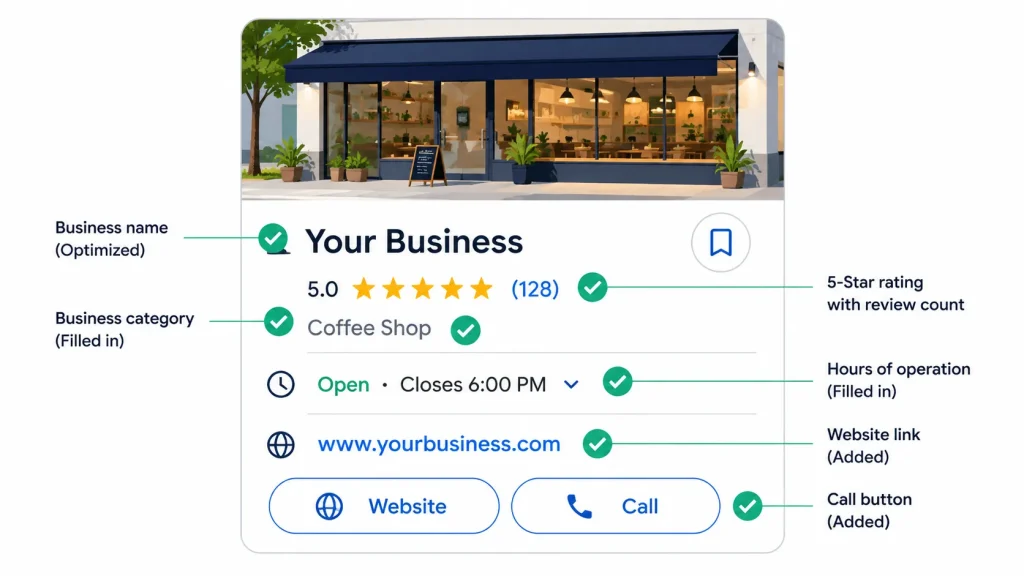
Your Google Business Profile (GBP) is the most important factor in local SEO. It is the listing that appears in Google Maps, the map pack, and the local panel on the right side of desktop search results.
To claim your profile: go to business.google.com, search for your business, and follow the verification process. Google typically verifies via postcard to your business address, which takes 5-14 days.
Once claimed, complete every section:
- Business name: Use your exact legal business name. Do not add keywords to the name field. Google flags this as spam and it can get your listing suspended.
- Category: Choose the most specific primary category that matches your main service. Add secondary categories for additional services.
- Address and hours: Accurate and complete. Hours should reflect when you are actually available, including holiday hours updated seasonally.
- Phone number: Use a local number, not a toll-free number. Local numbers are a trust signal for local SEO.
- Website: Link to your homepage or, if you have location-specific pages, the most relevant one.
- Services and products: List every service you offer with descriptions. Google uses this content to match your profile to relevant searches.
- Photos: Add at least 10 photos: exterior, interior, team, work samples, and products. Profiles with photos receive significantly more clicks than those without.
- Business description: Write 200-300 words describing what you do, who you serve, and where you are located. Include your city and main services naturally.
Step 2: What Is NAP Consistency and Why Does It Matter?
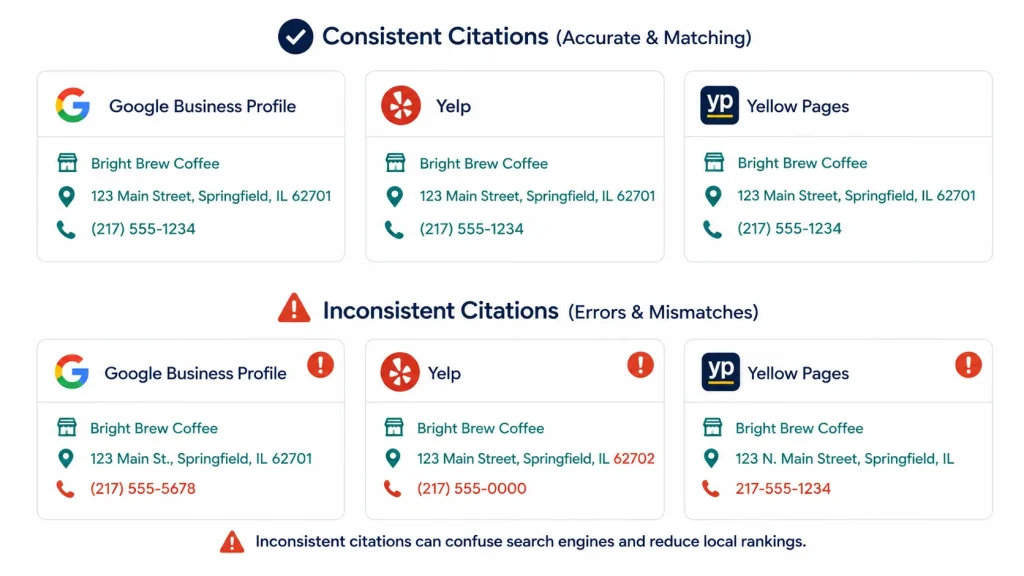
NAP stands for Name, Address, Phone Number. Google cross-references your business information across dozens of online directories to build confidence in who you are and where you are located. When your NAP information is inconsistent across these sources, Google’s confidence drops and local rankings suffer.
Common NAP inconsistencies that cause problems:
- ‘Street’ in one place, ‘St.’ in another
- Suite number included on your website but not on your GBP listing
- An old phone number still listed on Yelp or Yellow Pages from before you changed numbers
- A previous business address still appearing on data aggregator sites after you moved
The fix is a citation audit: a review of every place your business is listed online to find and correct inconsistencies. The most important directories to get right are Google Business Profile, Yelp, Facebook, Apple Maps, Bing Places, and the major data aggregators (Infogroup, Acxiom, Localeze). A digital marketing team familiar with local SEO can run this audit and submit corrections across all sources in a single engagement.
Step 3: How Do Customer Reviews Affect Local SEO Rankings?
Reviews are one of the most direct ranking signals for the Google map pack. Google weighs both the quantity and recency of reviews, the average rating, and whether you respond to reviews consistently.
What research shows about reviews and local rankings:
- Businesses in the top 3 map pack positions have an average of 472 reviews (BrightLocal Local Search Ranking Factors, 2023)
- Review recency matters: a business with 50 reviews in the last 6 months outranks one with 200 reviews spread over 5 years
- Responding to reviews, including negative ones, is a trust signal Google factors into ranking
- Keywords in review text (mentioning your city, service type) contribute to local relevance signals
How to get more reviews without violating Google’s guidelines:
- Ask satisfied customers directly, in person, immediately after a positive experience
- Send a follow-up email or text 24-48 hours after a completed job with a direct link to your Google review page
- Add a QR code to your receipt, invoice, or business card that links to the review form
- Respond to every existing review, positive and negative, within 48 hours
Google’s guidelines prohibit incentivizing reviews (offering discounts, gifts, or payment for reviews). Doing so risks having your listing suspended. Ask for honest reviews only.
Step 4: How Do You Optimize Your Website for Local Search?
Your website is the second major pillar of local SEO after your GBP. Several on-site changes directly affect local rankings.
Location Pages
If you serve multiple cities or neighborhoods, create a dedicated page for each location. Each page should mention the specific city, include a local phone number and address if you have one, reference local landmarks or context, and be genuinely different from your other location pages. Thin location pages that simply swap the city name are not useful to searchers and do not rank well.
Local Schema Markup
Schema markup is structured data added to your website that tells Google the specific details of your business: your NAP, hours, service area, price range, and more. A LocalBusiness schema on your homepage helps Google connect your website to your GBP listing and understand the geographic scope of your services.
Location Mentions in Content
Include your city and service area naturally in your homepage headline, about page, and service pages. ‘Chicago-based web design’ reads differently to Google than ‘web design services’ for a business trying to rank locally. This does not mean stuffing city names into every sentence. It means writing for a local audience and letting the geographic context appear where it naturally fits.
Embedded Google Map
Embed a Google Map showing your business location on your Contact page. It is a minor signal, but it is a free confirmation to Google that your address matches what is on your GBP listing.
Step 5: What Is Local Link Building and Does It Still Matter?
Local backlinks, links from other websites in your city or industry that point to your site, are a secondary but real local ranking factor. You do not need hundreds of them. A small number of relevant, local links add meaningful authority.
Practical local link building for a small business:
- Join your local Chamber of Commerce. Most include a directory link to members’ websites.
- Sponsor a local event, school fundraiser, or community organization. Sponsors typically receive a website link.
- Get listed on your city or neighborhood business directory if one exists.
- Partner with complementary local businesses for cross-referrals that include website links.
- Submit genuine guest posts or expert quotes to local news outlets or industry blogs.
Low-quality link schemes (paid links, link farms, mass directory submissions) can trigger Google penalties that are worse than no links at all. Quality and local relevance matter more than volume.
How Do You Track Whether Local SEO Is Working?
Three free tools cover the essentials:
- Google Business Profile Insights: Shows how many people found your profile via search vs Maps, what searches triggered your listing, and how many clicked for directions, called, or visited your website.
- Google Search Console: Shows which search queries your website pages appear for, which pages get clicks, and average ranking positions. Filter by location to see specifically local search performance.
- Google Analytics: Shows how much traffic comes from organic search, which pages visitors land on, and whether they complete a goal (contact form, call click, booking).
If GBP profile views and website clicks are growing month over month, and organic sessions from your target city are increasing, local SEO is working. The metric that matters most for a local service business is the number of calls or form submissions attributable to Google search. Connect Google Analytics goals to your contact form so you can track this directly.
Frequently Asked Questions
How long does local SEO take to see results?
For a business in a smaller city or a lower-competition category, meaningful improvements in map pack visibility can appear in 4-8 weeks after a complete GBP setup and NAP cleanup. In competitive metro markets or crowded service categories (law, dentistry, real estate), meaningful movement takes 3-6 months. Reviews are the fastest lever: a consistent monthly cadence of new reviews produces ranking improvements faster than almost any other single factor.
Do I need a physical address to rank in local search?
Not necessarily. Google supports service-area businesses (SABs) that operate from a home office or travel to customers rather than having a storefront. For a SAB, set up your GBP as a service-area business with your city and radius rather than a public address. You will still appear in local search for your service area, though you may have a slight ranking disadvantage compared to businesses with a verified physical location in the searched city.
Can I rank in multiple cities without having offices there?
To some degree. Creating location-specific pages on your website for each city you serve helps you rank in organic local results for those cities. Ranking in the map pack for a city where you do not have a physical address or GBP listing is very difficult. The strongest local map pack rankings consistently go to businesses with a verified address in or near the searched location.
How many Google reviews do I need to rank in the map pack?
There is no minimum threshold, but volume and recency both matter. In low-competition markets, 10-20 current reviews with a 4.0+ average can put a business in the top 3. In competitive markets, the top 3 businesses often have 100-500+ reviews. The more important factor is consistency: getting 2-3 new reviews per month outperforms a one-time push that stalls.
Does having a website matter for local SEO if I have a Google Business Profile?
Yes. Your GBP listing and your website work together. Google uses your website content to confirm and expand what your GBP says about your business. Businesses with no website tend to rank lower in local search than those with a functioning, optimized site. Your website also provides a destination for customers who want more information than the GBP listing shows, and it is where most contact form conversions happen.
Local SEO is one of the highest-return investments a local service business can make. The competition is usually narrower than national SEO, the searcher intent is higher, and the lead quality tends to be better because the person is already nearby and ready to act. The same principle applies whether you sell services, run an e-commerce store, or offer mobile app-based services to local customers.
The foundation is straightforward: a complete GBP, consistent NAP data, genuine reviews, and a website that confirms and expands what your listing says. Build that foundation consistently and the results compound.
If you want to know where your local SEO stands and what it would take to get into the map pack for your key services, get in touch with TruTransit Solutions. We start with an honest assessment of what is working and what is not before recommending any work.