
How to Choose the Right Mobile App Development Company (10 Things to Check)

To choose the right mobile app development company, check their portfolio for relevant apps in your category, confirm they run a discovery phase before development starts, ask about their technology stack and why they recommend it for your project, clarify code and IP ownership terms, understand their QA process, ask for client references you can actually contact, confirm post-launch support and maintenance terms, get a milestone-based timeline in writing, understand their communication process, and trust how clearly they answer all of the above. Vague answers to any of these are a warning sign worth following up on.
Hiring the wrong app development company is one of the most expensive mistakes a business can make. Not because the company is necessarily dishonest, but because mismatched expectations, unclear processes, and weak technical execution surface months into a project, after a significant portion of the budget is already spent.
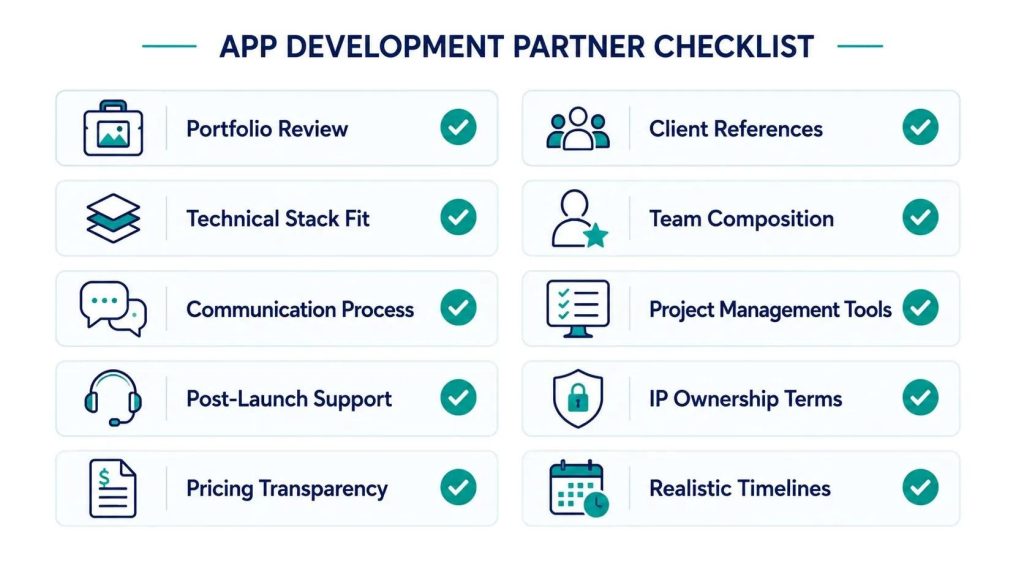
These 10 checks surface the differences that matter before you sign anything. If you are early in scoping a mobile app development project, working through this list with each company you evaluate will tell you more than any portfolio walkthrough.
The 10 Things to Check Before Hiring a Mobile App Development Company
1. Does Their Portfolio Include Apps Similar to Yours?
A polished portfolio is not the same as relevant experience. A company that has built consumer social apps may not be the right fit for a healthcare compliance app, even if both portfolios look impressive.
Ask specifically for examples in your category: similar complexity, similar industry, similar target user. If they have built e-commerce apps and you need an e-commerce app, that direct relevance matters more than general polish. If they cannot show relevant examples, ask how they would approach the specific challenges of your category.
2. Do They Run a Discovery Phase Before Development Starts?
A company that jumps straight into design or development without first understanding your business goals, target users, and technical requirements is building on assumptions. A proper discovery phase produces a clear specification document, a feature priority list, and often wireframes before any code is written.
What a strong answer sounds like: they describe a structured intake process with specific deliverables. What a weak answer sounds like: “We can start building right away.” Speed without a clear spec usually means rework later.
3. What Is Their Technology Stack, and Why Do They Recommend It?
Ask whether they build native, cross-platform, or both, and why they recommend a specific approach for your project rather than defaulting to whatever they happen to specialize in. A company that always recommends the same framework regardless of project requirements is optimizing for their own convenience, not your outcome. Compare their recommendation against an honest cross-platform versus native analysis of your specific use case.
4. Who Owns the Code and Intellectual Property After Launch?
This should be unambiguous in the contract. You want full ownership of the source code, design files, and any custom assets created for your project. Some companies retain rights to reusable components or frameworks they built independently, which is reasonable, but the application code specific to your business should be yours outright.
Clarify this before signing, not after a dispute arises. Ask to see the relevant IP and ownership clause in their standard contract.
5. What Does Their QA and Testing Process Look Like?
A serious development company has a defined QA process: functional testing against the spec, device and OS version testing, performance testing, and security testing for apps handling sensitive data. Ask how many devices and OS versions they test on, whether QA is a dedicated role separate from development, and how bugs are tracked and prioritized.
Companies that treat testing as an afterthought, done quickly right before launch, tend to ship apps with bugs that surface after release, when fixing them is more disruptive and costly.
6. Can You Talk to Past Clients Directly?
Portfolio case studies are curated. A direct conversation with a past client reveals what the portfolio does not: how communication felt during the project, whether timelines were realistic, how problems were handled, and whether the client would hire them again.
A company confident in its work will connect you with references without hesitation. Reluctance or excuses about confidentiality for every single past client is worth probing further.
7. What Does Post-Launch Support Actually Include?
Every app needs maintenance: bug fixes, OS compatibility updates, security patches, and often feature additions based on user feedback. Clarify what is included after launch, for how long, and what costs extra.
- Standard maintenance period: Many companies include 30-90 days of bug fixes post-launch at no extra cost
- Ongoing maintenance plans: Usually a monthly retainer covering OS updates, security patches, and minor fixes
- Feature development: Typically billed separately from maintenance, scoped per request
Confirm this in writing. A vague “we’ll be here if you need us” is not a maintenance plan.
8. Do They Provide a Milestone-Based Timeline?
A single launch date with no intermediate checkpoints makes it impossible to know whether a project is on track until the deadline arrives, by which point any problems are expensive to fix. A proper timeline includes named milestones: discovery completion, design sign-off, development sprints, QA completion, and submission.
This connects directly to realistic expectations about how long app development takes. A company that gives you a single date with no visible structure behind it has either not scoped the project properly or is not being transparent about how the work breaks down.
9. How Do They Communicate During the Project?
Ask about their communication cadence: weekly check-ins, sprint demos, a shared project management tool, a dedicated point of contact. Mismatched communication expectations are one of the most common sources of client frustration during a development project, independent of the quality of the actual work.
If you need frequent updates and they propose monthly check-ins, or if you prefer less frequent contact and they want daily standups, address this mismatch before the project starts rather than discovering it mid-build.
10. How Clearly Do They Answer All of the Above?
This is the meta-question. A company with a mature process answers these nine questions specifically, confidently, and without defensiveness. A company that deflects, gives vague generalities, or seems annoyed by the questions is showing you exactly how the actual project will go.
The quality of the sales conversation is not a guarantee of project quality, but a company that cannot clearly explain its own process during the sales conversation is unlikely to suddenly develop process clarity once the contract is signed.
What Are the Warning Signs When Evaluating App Development Companies?
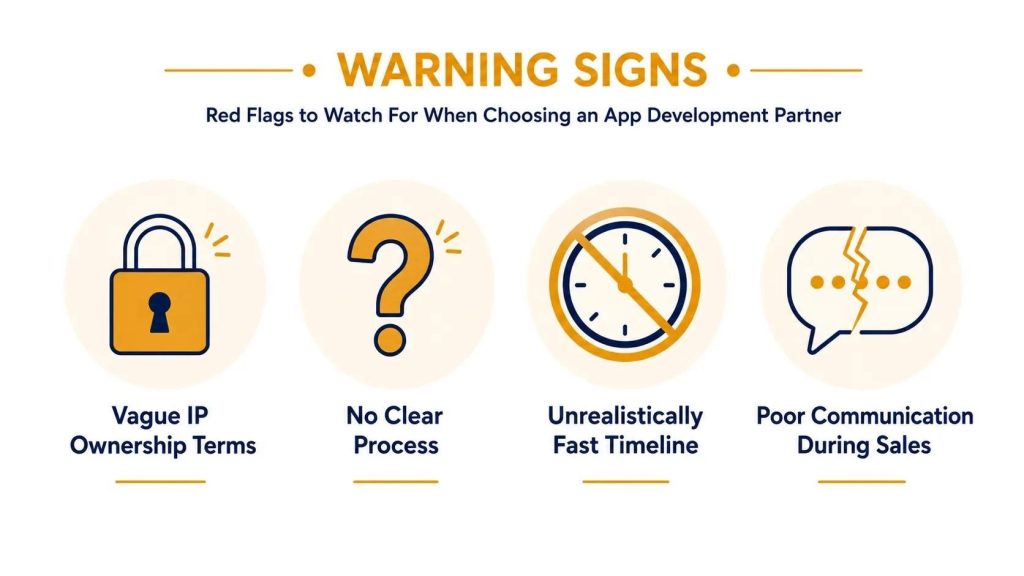
| Warning Sign | What It Usually Indicates |
|---|---|
| No discovery phase mentioned | Development will start on assumptions, not your actual requirements |
| Quote given without seeing a written spec | The estimate is not based on your project; expect significant variance later |
| Cannot provide any client references | Limited verifiable track record, or past client relationships did not end well |
| Vague on IP ownership | Risk of disputes over who owns the final code and assets |
| No mention of QA process when asked | Testing may be minimal, increasing the risk of bugs at launch |
| Pressure to sign quickly with discounts for fast decisions | Sales-driven approach over a considered project fit assessment |
| Communication is slow or unclear during the sales process | Likely to be slow or unclear during the actual project |
Should You Choose an Agency, a Freelancer, or an In-House Team?
| Freelancer | Agency | In-House Team | |
|---|---|---|---|
| Cost | Lowest hourly rate; variable total cost | Higher rate; predictable project-based pricing | Highest fixed cost; ongoing salaries |
| Best for | Simple apps, tight budgets, MVPs | Multi-feature apps, ongoing partnership, full-service needs | Long-term products with continuous development needs |
| Skill coverage | Single person’s expertise | Designers, developers, QA, and project management together | Depends entirely on who is hired |
| Risk | Single point of failure if unavailable | More structure and accountability | High overhead; slower to scale up or down |
| Post-launch support | Often informal or limited | Usually structured maintenance plans available | Built-in, but requires ongoing headcount investment |
For most businesses building their first app, an agency offers the best balance of cost, skill coverage, and structured process. As the product matures and development needs become continuous, transitioning to an in-house team or a hybrid model often makes sense. Many businesses also evaluate staff augmentation as a middle path between fully outsourced and fully in-house development.
Frequently Asked Questions
Should I choose a local company or work with a remote development team?
Either can work well. Local companies offer easier in-person meetings and the same time zone, which some businesses value for collaboration. Remote teams, including offshore options, can offer cost savings but require more deliberate communication processes to manage time zone gaps and avoid misunderstandings. The quality of the work depends more on the company’s process and expertise than on geography. Evaluate based on the 10 factors above regardless of location.
How do I verify a development company’s claimed experience?
Ask for live app store links to apps they have built, not just screenshots or mockups. Check the app’s reviews and ratings, which reflect real user experience with their work. Request direct contact with at least two past clients. Search for the company on review platforms like Clutch or GoodFirms, which collect verified client reviews specifically for B2B service providers.
What is a reasonable deposit or payment structure for an app development project?
Common structures include a percentage upfront (often 20-30%) with the remainder tied to milestones (design approval, development phases, launch), or fully milestone-based payments with no large upfront commitment. Be cautious of companies requesting more than 50% upfront with no milestone structure, as this reduces your leverage if the relationship does not work out as expected.
How many companies should I get quotes from before deciding?
Three to five conversations is usually enough to understand the range of approaches and pricing in the market without spending excessive time on the vendor selection process itself. Going through the 10-point checklist with each one will surface clear differences quickly. Past five or six conversations, the additional information rarely changes the decision and mostly extends your timeline to actually starting the project.
What happens if the relationship with the development company does not work out mid-project?
This is exactly why IP ownership, milestone payments, and clear documentation matter from the start. If code, design files, and project documentation are properly owned by you and well-documented throughout, switching development partners mid-project, while disruptive, is possible. If those elements are unclear or controlled entirely by the vendor, switching becomes much harder and more expensive. Address this risk in the contract before you need it.
Choosing a mobile app development company is a decision that compounds over months of working together. The ten checks above surface the differences that matter most before you commit budget and time to a partnership.
The companies that answer these questions clearly and specifically are showing you how the actual project will run. Trust that signal more than the polish of the pitch.
If you want to run through this checklist directly, talk to the team at TruTransit Solutions. We will walk you through our process, share relevant work, and give you a straightforward answer on whether we are the right fit for your project.