

To choose the right web design agency, ask about their process before design starts, request examples from your industry, clarify who owns the site after launch, confirm whether SEO is included, understand the revision and handover process, check what ongoing support looks like, and get a clear timeline with milestones in writing. The agency that answers these questions confidently and specifically is the one worth hiring.
Most businesses do not regret spending money on a web design agency. They regret spending it on the wrong one.
A bad agency relationship costs more than the invoice. It costs time in back-and-forth, a site that does not perform the way you expected, and the pain of either fixing it or starting over. The good news is that the difference between a strong agency and a frustrating one usually shows up in the conversation before any contract is signed.
These seven questions are designed to surface that difference. Whether you are evaluating a single agency or comparing several, the answers will tell you more than a portfolio will. And if you are still early in the process, our web design and development services page explains how we approach each of these areas.
The 7 Questions to Ask a Web Design Agency Before You Sign
1. What Does Your Process Look Like Before Any Design Starts?
A good agency does not open Figma on day one. There should be a discovery phase where they ask about your business goals, your customers, your competitors, and what the site needs to accomplish. Design decisions made without this context tend to produce sites that look good but do not work for the specific business.
What a strong answer sounds like: the agency describes a clear intake process, explains what questions they ask, and can tell you how those answers shape the design direction. They should mention things like customer journey mapping, competitor review, or conversion goals.
What a weak answer sounds like: “We look at your existing site and get started.” Or a portfolio walkthrough without any mention of strategy.
2. Can You Show Me Work You Have Done for a Business Like Mine?
A portfolio is more useful when the examples match your context. An agency that has built e-commerce sites for retail brands is not the same as one that builds lead-generation sites for local service businesses, even if both portfolios look polished.
Ask specifically for examples that share your industry, your site’s primary goal (leads, sales, bookings), or your customer type. If the agency has built sites for healthcare, real estate, or professional services, those examples are more predictive of your outcome than a beautifully designed tech startup site.
If they cannot show you relevant examples, ask how they would approach your category. An honest answer that acknowledges the gap is more reassuring than a vague claim that “we design for all industries.”
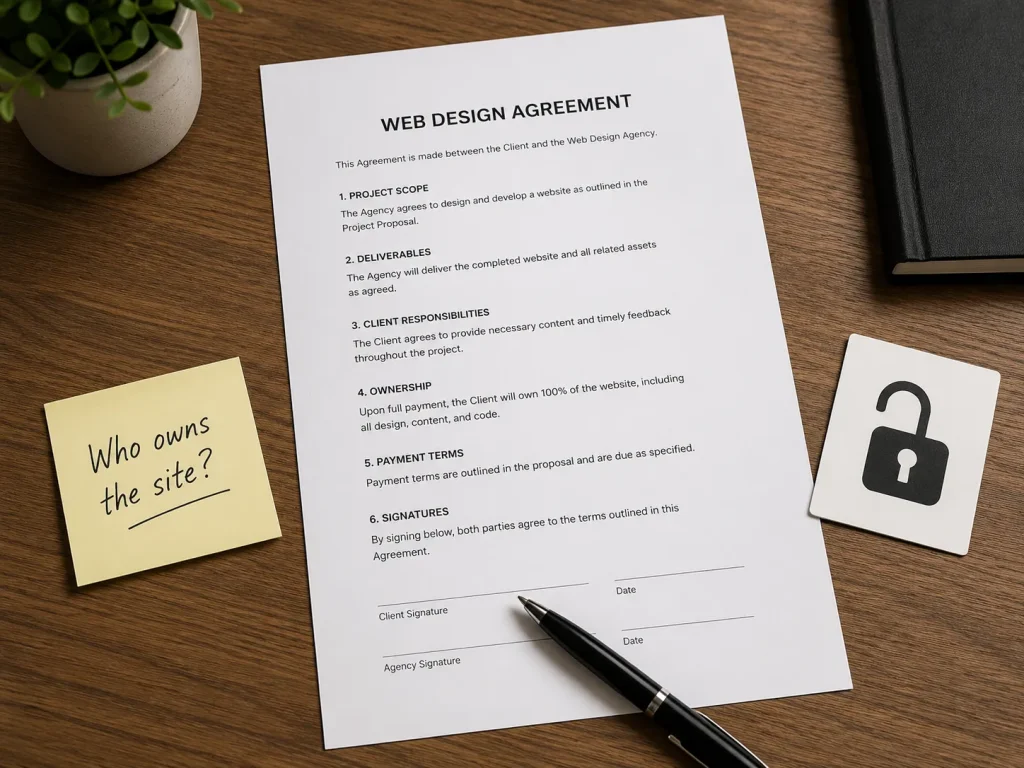
3. Who Owns the Website After Launch?
This question catches more businesses off guard than any other. Some agencies build on proprietary platforms or retain control of the hosting, code, or CMS in ways that make it difficult to move the site later without starting from scratch.
What you want to hear: you own the domain, the hosting is in your name or transferable, the CMS is a standard platform (WordPress, Webflow, Shopify), and you receive full access to all files and credentials at handover.
What to watch for: agencies that lock hosting into their own packages as a condition of the build, or that deliver a site on a platform where only they can make code-level changes. This is not always a red flag — some managed solutions are genuinely good — but you need to understand what you are agreeing to before you sign.
4. Is SEO Included, and What Does That Actually Mean?
Most agencies say SEO is included. Fewer actually deliver the fundamentals. There is a significant difference between basic on-page setup and a site that is genuinely optimized for search from the ground up. Our digital marketing and SEO services page outlines what a proper SEO foundation involves — it is a useful benchmark when evaluating what agencies include in their builds.
A properly SEO-ready website should include, at minimum:
- Optimized title tags and meta descriptions for every page
- Correct heading hierarchy (H1, H2, H3) with target keywords
- An XML sitemap submitted to Google Search Console
- Mobile-responsive design that passes Core Web Vitals benchmarks
- Clean URL structure with no duplicate content or redirect chains
- Schema markup on key pages (at minimum: LocalBusiness and Organization)
If the agency describes SEO as “adding keywords to the text,” that is a gap. Press for specifics. A site launched without these foundations needs remediation work before it will rank for anything.
5. How Many Revision Rounds Are Included, and What Is the Handover Process?
Revision scope is where many agency relationships become difficult. Without a clear agreement on how many rounds of changes are included and what counts as a revision versus a new request, projects can stall or generate unexpected invoices.
What to clarify upfront:
- How many revision rounds are included at each stage (wireframes, visual design, development)
- Whether content changes after development starts count as revisions or change requests
- What the handover process looks like: do you get a walkthrough? Written documentation? Training on the CMS?
- What format the final files are delivered in, and who holds login credentials
The agencies that handle this clearly have done it enough times to know where projects get stuck. Vague answers here often predict vague project management later.
6. What Does Ongoing Support Look Like After Launch?
Every website needs maintenance: security updates, plugin or platform updates, occasional content changes, and performance monitoring. The question is whether the agency provides this, at what cost, and what happens if you choose not to use their maintenance service.
Reasonable ongoing costs for a professionally built small business site run $75-$200 per month for managed maintenance. That typically covers security monitoring, platform updates, uptime checks, and small content edits. Development work (new pages, new features) is usually billed separately.
The more important question is what you can handle yourself. A well-built WordPress or Shopify site lets a non-technical owner make basic content changes without a developer. A site built on a proprietary platform or with a complex custom stack often cannot. If self-sufficiency matters to you, ask what the CMS experience looks like for a non-developer, and whether they offer a brief training walkthrough at launch. This connects directly to the type of web development approach the agency uses.
7. What Is the Timeline, and What Are the Milestones?
A timeline without milestones is not a timeline. You need to know when specific deliverables are expected, what you are responsible for at each stage, and what happens if either side misses a deadline.
A realistic small business website takes 4-8 weeks from kickoff to launch, assuming client content is delivered on time. The most common reason projects run long is late content delivery from the client side, not slow development. An agency that does not tell you this upfront either has not done enough projects to know it or is not being straight with you.
Ask for a project timeline document with named milestones, not just a single launch date. It should show: discovery completion, wireframe delivery, design review, development start, review period, final amends, and launch.
What Are the Red Flags to Watch for When Evaluating a Web Design Agency?
The questions above surface most issues. But there are a few patterns worth naming directly.
| Red Flag | What It Usually Means |
|---|---|
| No discovery phase mentioned | Design will be based on guesswork, not your business goals |
| Portfolio only shows visual design, no metrics or outcomes | The agency optimizes for aesthetics, not performance |
| Vague on SEO: “yes it’s included” with no specifics | Basic keyword insertion only; no technical SEO foundation |
| Hosting locked into agency package | You may not own the site outright; moving later is costly |
| “We can start tomorrow” | No intake process, no scoping — rushed builds miss requirements |
| No written scope of work before contract | Scope creep risk is high; disputes are hard to resolve without it |
| No maintenance plan or CMS training offered | You will need to pay for every small change after launch |
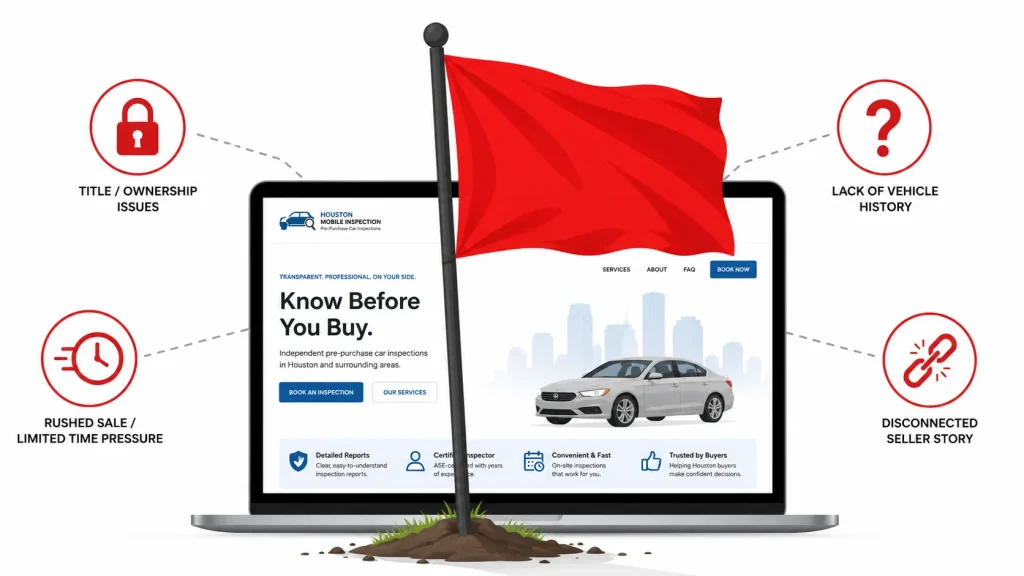
None of these are automatic disqualifiers — context matters. But each one warrants a follow-up question before you move forward.
Should You Choose an Agency or a Freelancer?
This comes down to the complexity of what you are building and how much coordination you can handle yourself.
| Freelancer | Agency | |
|---|---|---|
| Best for | Simple sites, tight budgets, quick turnarounds | Multi-page sites, SEO requirements, ongoing support |
| Cost range | $300-$5,000 typical | $3,000-$15,000+ typical |
| Availability | Variable; often juggling multiple clients | Structured project management, dedicated point of contact |
| Skill coverage | One person’s skill set | Designers, developers, SEO, and strategy in one team |
| Risk | Single point of failure if they go offline | More accountability; contracts and processes in place |
| Ongoing support | Often limited or informal | Typically structured maintenance packages available |
For businesses where the website is a primary lead source, an agency build is usually worth the higher cost. For a basic five-page presence while you validate a business idea, a skilled freelancer or even a well-configured template can serve the purpose. And if your needs extend beyond the website itself — to mobile app development, branding, or digital marketing — a full-service agency means one team holds the context across all of it.
Frequently Asked Questions
How do I know if a web design agency is legitimate?
Check for a real portfolio with live URLs you can visit, verifiable client reviews on platforms like Google or Clutch, a physical business address, and a clear process for how they scope and manage projects. Any agency worth hiring should be able to walk you through a recent project end to end, including what the client wanted, what decisions were made, and what the outcome was.
How long should a web design contract be?
A typical small business website project contract covers the build phase: usually 4-12 weeks. Ongoing maintenance is usually a separate monthly agreement. The contract should include scope of work, deliverables, timeline, revision policy, payment schedule, ownership of assets, and what happens if either party needs to exit the agreement.
What should a web design agency ask me before starting?
A thorough agency will ask about your target customers, your primary business goal for the site, your competitors, any existing brand guidelines, your budget range, your timeline, who is responsible for providing content, and what success looks like six months after launch. If an agency does not ask most of these questions in the first conversation, they are not doing discovery — they are just getting started.
Is a cheaper agency always a worse choice?
Not necessarily. Price reflects overhead, team size, and process maturity, not always output quality. A small focused agency or an experienced independent team can produce excellent work at lower rates than a large agency with high operational costs. The questions above matter more than the price point. A $3,000 site built with a clear process and proper SEO setup will outperform a $10,000 site built without one.
What happens if I am unhappy with the work mid-project?
This is why the revision policy and scope of work matter before you sign. If revisions are clearly defined and the project has named milestones, disagreements are resolvable. If scope is vague, mid-project disputes become difficult and expensive. Ask specifically: what is the process if the design direction is not working after the first round? A clear, confident answer to that question is a good sign.
Choosing a web design agency is not a complicated decision if you ask the right questions early. The agencies that answer clearly, specifically, and without defensiveness are the ones worth working with. The ones that deflect, overpromise, or get vague when pressed on process are showing you exactly how the project will go.
Take the time to ask all seven questions before any contract is signed. The answers tell you more than any portfolio walkthrough.
If you want to run through these questions with us directly, book a free consultation with TruTransit Solutions. We will walk you through our process, show you relevant work, and give you a straight answer on whether we are the right fit for your project.
2 Responses
Rongbbachkim, eh? Just gave ’em a looksee. Seems promising, alright? You might dig it! rongbbachkim
Thanks for stopping by and sharing your thoughts! We appreciate your recommendation and are glad you took the time to leave a comment on our blog. Thanks for being part of our community!