


A small business website in 2026 typically costs between $500 and $15,000 depending on the type of site, the platform, and who builds it. A basic brochure site runs $500-$3,000. A professionally designed site with SEO and custom features costs $3,000-$10,000. Fully custom builds with integrations start at $10,000 and up. Ongoing costs (hosting, maintenance, updates) add $50-$300 per month on top.
Most business owners ask about website cost and expect a simple number. There isn’t one, but there is a framework that makes the answer clear for your specific situation.
The price of a website depends on four things: what type of site you need, who builds it, what platform it runs on, and what it needs to do after it launches. If you are already evaluating options, TruTransit’s web design and development services page breaks down what each engagement covers. Here is the full cost picture.
What Are the Main Types of Small Business Websites and What Do They Cost?
The biggest cost driver is the type of website you need. A five-page brochure site and a 50-product e-commerce store are completely different projects, even if they look similar from the outside.
| Website Type | What It Includes | Typical Cost Range |
|---|---|---|
| Starter / Brochure Site | 3-5 pages, contact form, basic mobile design | $500-$2,500 |
| Professional Business Site | 6-15 pages, SEO setup, custom design, blog | $2,500-$7,000 |
| E-Commerce Store | Product pages, cart, payment integration, inventory | $4,000-$15,000 |
| Booking or Appointment Site | Calendar integration, service listings, client portal | $3,000-$8,000 |
| Custom Web Application | Complex logic, user accounts, third-party APIs | $10,000-$50,000+ |
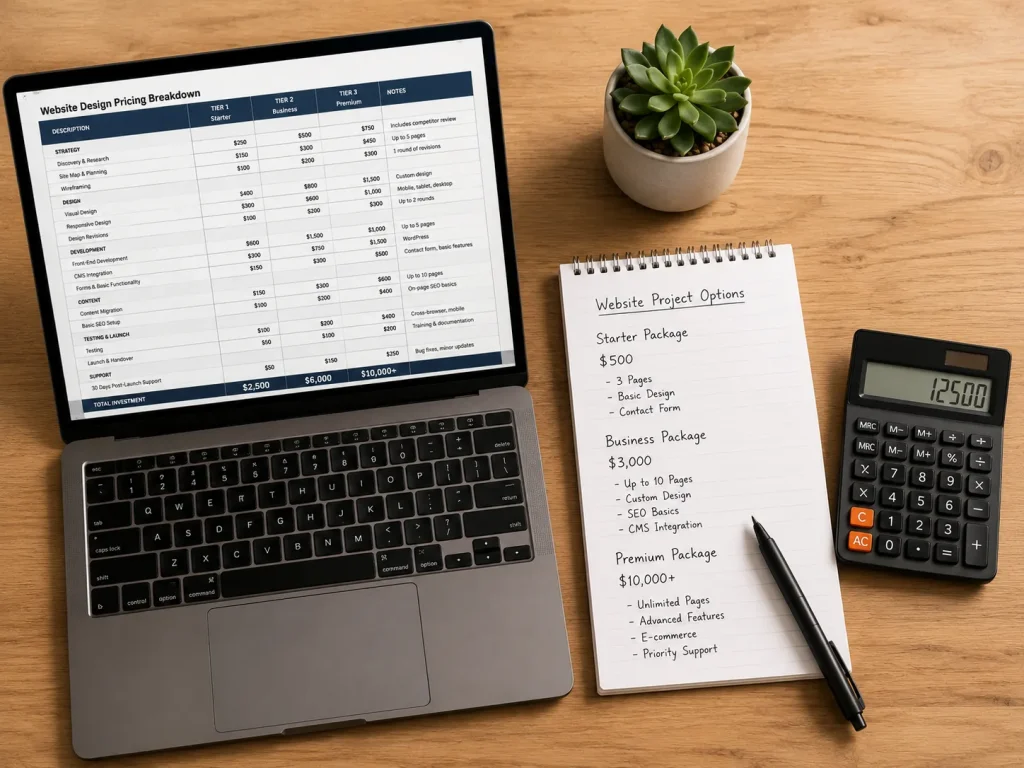
These ranges assume professional development. If you are building an online store specifically, the e-commerce development process involves more than the website itself: payment gateways, inventory systems, and checkout optimization all add to the scope. DIY builders reduce upfront cost but introduce real trade-offs in SEO performance and long-term flexibility.
Who Builds the Site and How Much Does That Affect Price?
Significantly. The same five-page website can cost $300 from a budget freelancer or $6,000 from a full-service agency. The price difference reflects scope, process, and what happens after the site goes live, not just the design itself.
Here is a realistic comparison:
| Builder Type | Cost Range | What You Get | What to Watch For |
|---|---|---|---|
| DIY (Wix, Squarespace) | $0-$50/mo | Templates, drag-and-drop editor | Limited SEO, no custom code, vendor lock-in |
| Freelancer (budget) | $300-$1,500 | Basic build, limited revisions | Variable quality, no ongoing support |
| Freelancer (experienced) | $1,500-$5,000 | Custom design, more responsive | Single point of failure, handoff risks |
| Digital Agency | $3,000-$15,000+ | Strategy, design, development, SEO | Higher upfront cost; typically includes ongoing support |
| Full custom development | $10,000-$50,000+ | Built from scratch, unique functionality | Long timelines, high maintenance overhead |
For most small businesses, the realistic sweet spot is a professional agency build in the $3,000-$7,000 range. You get a site designed with your customers in mind, built on a platform you can update yourself, and optimized from day one for search.
What Platform Should Your Website Run On?
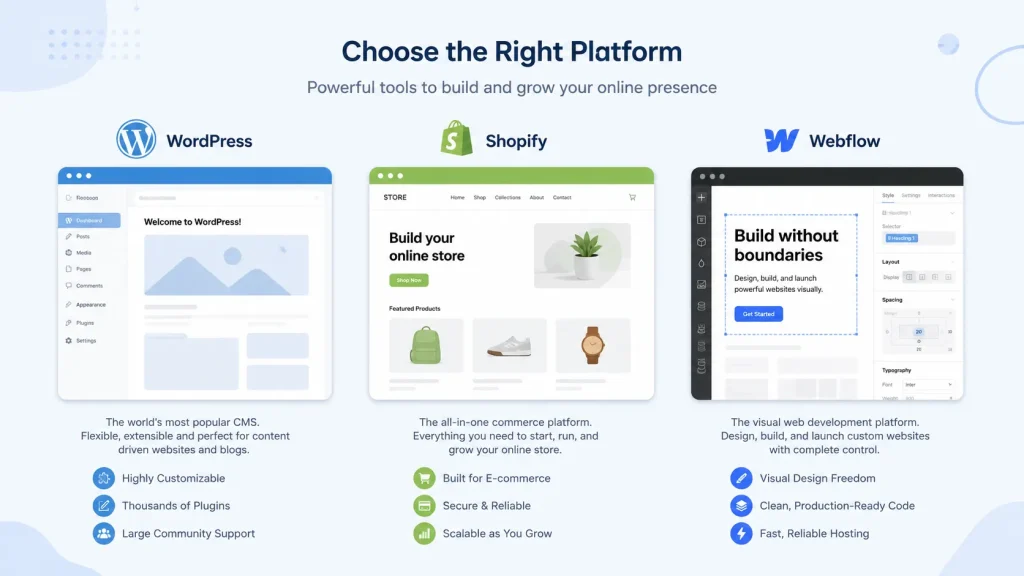
For most small businesses, WordPress or Shopify will cover what you need. WordPress suits service businesses and content-heavy sites; Shopify is built for selling products. The platform you choose also shapes how much SEO and digital marketing work is possible out of the gate — some platforms make on-page optimization much easier than others.
WordPress is the most widely used platform for small business sites, powering over 43% of all websites globally according to W3Techs. It is flexible, SEO-friendly, and has a large ecosystem of developers and tools. Most professionally built small business sites run on WordPress.
Shopify is the default choice for e-commerce. It handles payments, inventory, and product management out of the box. Monthly costs run $39-$399 depending on your plan, plus transaction fees if you use an external payment gateway.
Webflow is growing in popularity for businesses that want design-forward sites without heavy development overhead. It costs more to build on than WordPress but gives designers more control over the final output.
Custom-built sites (React, Next.js, Laravel) make sense when your site needs to do something none of the platforms handle well: complex user dashboards, real-time features, or unique third-party integrations. These cost the most and require ongoing developer support.
What Hidden Costs Do Small Business Websites Actually Have?
The build cost is the starting point, not the total cost. Every website has ongoing expenses that catch business owners off guard.
Annual and monthly costs to budget for:
- Domain name: $10-$20 per year (you pay this whether you build or use a DIY platform)
- Web hosting: $10-$100 per month depending on traffic and plan (managed WordPress hosting typically runs $25-$60/mo)
- SSL certificate: Usually included with hosting, but confirm this before you sign
- Premium plugins or apps: $5-$50 per month each for tools like booking systems, SEO plugins, or payment processors
- Maintenance and security updates: $50-$200 per month if you want a developer managing updates and backups
- Content updates: If you cannot make edits yourself and need a developer for every change, factor in hourly costs ($75-$150/hr)
A realistic annual cost of ownership for a professionally built small business site runs $1,200-$4,000 after the build. That includes hosting, security, and occasional updates. E-commerce sites run higher due to platform fees and heavier maintenance.
What Should a $3,000-$5,000 Website Actually Include?
A $3,000-$5,000 professional website build should cover design, development, SEO setup, and a platform you can maintain yourself. Here is what to expect at this price point, and what typically sits outside of it.
At this price point, you should expect:
- A discovery phase where the agency asks about your customers, goals, and competitors before touching any design
- A custom-designed layout built specifically for your brand, not a template with your logo swapped in
- A mobile-responsive build that works on phones as well as desktops
- On-page SEO setup: optimized title tags, meta descriptions, H1 headings, and a sitemap submitted to Google
- A content management system you can update without a developer
- Basic speed optimization so the site loads under 3 seconds on mobile
- A contact form with working email notifications
- Google Analytics and Google Search Console connected and tracking
What it typically does not include at this range: custom animations, e-commerce functionality, booking system integrations, or more than 10-12 pages. Those add cost, and a straightforward agency will tell you that before the project starts.
Is a Cheap Website Worth It for a Small Business?
It depends on what you mean by cheap. A $500 website built on a solid WordPress template with good SEO fundamentals can perform well for a local service business. A $500 website built by the cheapest bidder on a freelance platform, with no SEO, slow load times, and a theme that breaks on mobile, is an active liability.
The question is not whether to spend less. It is whether the site will actually work for your business goals. A site that loads slowly on mobile, has no clear calls to action, and cannot be found in search is not a cheap website. It is an expensive one that did not pay off.
From the sites we have built and audited at TruTransit Solutions, a web design and digital marketing agency based in Wood Dale, IL, the most common issue we see is not that a small business spent too little. It is that they spent on the wrong things. Design without SEO. Pages without conversion goals. Builds without a clear plan. And often, businesses outgrow a basic site quickly — especially those moving toward mobile app development or a more complex digital presence down the line.
The cost conversation is really a value conversation. A $4,000 website that earns you one new client per month pays for itself in a quarter. A $900 website that generates no leads costs more over time.
Frequently Asked Questions
How much should a small business budget for a website in 2026?
For a professional, functional website that ranks in search and converts visitors, budget $3,000-$7,000 for the build and $100-$300 per month for hosting and maintenance. Simpler sites cost less. E-commerce and custom builds cost more. The build cost is a one-time investment; the ongoing costs are what most business owners underestimate.
Can I build my own website instead of hiring someone?
Yes, and for very small businesses or side projects, DIY platforms like Wix, Squarespace, or WordPress.com are a reasonable starting point. The trade-offs are real though: limited SEO capability, design constraints, and no technical support when something breaks. If your website is a primary source of leads or revenue, professional development pays for itself faster than most people expect.
Does a more expensive website rank higher on Google?
Not automatically. Google does not care how much you spent. What Google cares about is page speed, mobile usability, quality content, and technical SEO. A $10,000 site with no SEO work will be outranked by a $3,000 site that was built with search in mind from the start. Build cost and SEO performance are separate, though a good agency addresses both together.
How long does a small business website last before needing a rebuild?
Most small business websites hold up well for 3-5 years before the design starts feeling dated or the platform becomes difficult to maintain. Regular content updates and annual maintenance extend the lifespan. The trigger for a rebuild is usually a change in business direction, a major platform update, or a site that is clearly underperforming on mobile.
What is the difference between a website redesign and a website rebuild?
A redesign changes the visual layer: new colors, new layouts, updated imagery. A rebuild replaces the underlying structure, platform, or code. Redesigns typically cost 40-60% of the original build cost. Rebuilds cost as much as a new site, sometimes more, because of the added complexity of migrating existing content and preserving SEO rankings during the transition.
The right website budget is the one that matches what you need the site to do. A business that relies on local walk-in traffic needs something different from one building a national e-commerce brand, and the pricing should reflect that difference, not a one-size number.
If you want a straightforward conversation about what a website actually costs for your specific situation, get in touch with TruTransit Solutions. We scope projects honestly and will not recommend more than your business needs right now.
4 Responses
Great experience so far. The games load quickly and I haven’t encountered any lag during the big wins. Keep it up idmaimun88!
Thank you for your feedback! We’re glad to hear you’ve had a smooth experience. We appreciate your support and look forward to keeping things running smoothly for you!
I have tried dozens of slot platforms and this one actually stands out. The volatility options match different play styles perfectly and the win frequency feels completely natural. No hidden terms and the payout speed is impressive for a casual session. hoki108slotgacor
Thank you for sharing your feedback! We appreciate you taking the time to comment and are glad you enjoyed the experience. Your support means a lot to us!