


A standard small business website takes 3-6 weeks to build from kickoff to launch. A simple brochure site can be live in 2-3 weeks. An e-commerce store typically takes 6-10 weeks. Custom web applications run 12-20 weeks or longer. The most common reason any website takes longer than expected is late content delivery from the client side, not slow development.
When a client asks how long their website will take to build, the honest answer starts with a question: what kind of site is it?
A five-page service site and a 300-product online store are both websites. Their timelines are completely different. So are the timelines for a booking platform, a custom web app, and a landing page campaign. The type of site is the first variable. The second is how prepared the client is when the project starts.
This guide breaks down realistic timelines for every major website type, explains what drives each phase, and covers what to prepare before your web design project kicks off so your launch date does not slip.
How Long Does Each Type of Website Take to Build?
These timelines assume a professional agency or experienced developer, content delivered on time by the client, and a standard number of revision rounds. Each range reflects realistic project durations, not best-case scenarios.
| Website Type | Typical Timeline | What Drives the Range |
|---|---|---|
| Landing page (single page) | 1-2 weeks | Complexity of design, whether copywriting is included |
| Brochure site (3-5 pages) | 2-3 weeks | Number of pages, existing brand assets, content readiness |
| Professional business site (6-15 pages) | 4-6 weeks | Design complexity, number of revision rounds, content volume |
| Portfolio or photography site | 2-4 weeks | Image volume and optimization, gallery setup, CMS requirements |
| Booking or appointment site | 4-8 weeks | Calendar integration, booking logic, payment setup |
| E-commerce store (up to 50 products) | 6-10 weeks | Product setup, payment gateway, shipping logic, inventory structure |
| E-commerce store (50+ products) | 10-16 weeks | Product data migration, custom filters, third-party integrations |
| Membership or subscription site | 8-14 weeks | User account logic, gated content, payment recurring setup |
| Custom web application | 12-24+ weeks | Scope complexity, backend architecture, testing requirements |

These are professional build timelines. DIY platforms like Wix or Squarespace can get a basic site live faster, but that speed comes with trade-offs in SEO performance, customization, and how the site scales with your business.
What Are the Phases of a Web Design Project and How Long Does Each Take?
Understanding where time goes in a web project helps you manage your own expectations and keep the project moving. Most professional website builds move through the same phases, regardless of size.
Phase 1: Discovery and Scoping (3-7 Days)
This is where the agency learns about your business, customers, goals, and competitors. You will be asked for any existing brand assets, examples of sites you like, and clarity on what the site needs to accomplish. Some agencies run this as a paid discovery engagement. Others include it in the project.
What slows this phase down: unclear business goals, stakeholders who have not aligned on what the site should do, or clients who provide examples without explaining why they like them.
Phase 2: Wireframing and Site Architecture (3-7 Days)
The developer or designer maps out the structure of each page before any visual design starts. This shows where content, navigation, calls to action, and media will sit. Wireframes are reviewed and approved before moving to design.
What slows this phase down: late feedback, approval processes that involve multiple internal stakeholders, or requests to restructure page logic after wireframes are signed off.
Phase 3: Visual Design (5-10 Days)
Colors, typography, imagery, and branded elements are applied to the approved wireframe. This is where the site starts to look like the finished product. Good visual design at this stage depends heavily on having clear brand guidelines in place. Without them, the designer makes visual decisions by inference, which often generates more revisions.
What slows this phase down: absent or inconsistent brand assets, requests for significant design changes after approval, or unclear feedback (“I don’t love it” without specifics).
Phase 4: Development (7-20 Days Depending on Complexity)
The approved design is built into working code. Pages are connected, forms are wired, the CMS is configured, and the site is populated with content on a staging environment. For e-commerce sites, this phase includes product setup, payment gateway configuration, and checkout logic.
Development time scales directly with complexity. A five-page brochure site takes less than a week to develop. An e-commerce store with inventory management, custom filters, and payment integration can take three to four weeks of development time alone.
Phase 5: Content Population (3-7 Days, Often Overlapping Development)
Copy, images, logos, and any other content assets are placed into the site. If the client provides content, this phase runs faster. If the agency is writing copy or sourcing imagery, it is a separate workstream that needs to be scoped and scheduled.
This phase is the most common source of project delays. Clients underestimate how long it takes to write page copy, gather photos, or get internal approvals on messaging. Having content ready before development starts is the single most effective way to protect your launch timeline.
Phase 6: Testing, Review, and Launch (5-10 Days)
The site is tested on multiple devices and browsers, forms are verified, load speed is checked against Core Web Vitals benchmarks, and any outstanding amends are resolved. Once sign-off is received, the site is moved to the live server, DNS is updated, and the launch is confirmed.
What slows this phase down: last-minute content changes, additional pages added outside the original scope, or DNS issues on domains managed by third-party registrars.
What Actually Causes Website Projects to Run Late?
Most project delays are predictable. They follow the same patterns across nearly every website build, regardless of agency or platform.
| Delay Cause | How Common | How to Prevent It |
|---|---|---|
| Client content not ready at development start | Very common | Prepare all copy, images, and logo files before kickoff — not during |
| Internal stakeholder review takes longer than expected | Common | Agree on a single decision-maker before the project starts |
| Scope additions mid-project | Common | Define scope precisely in writing before signing; log change requests formally |
| Vague or delayed feedback on designs | Common | Set a feedback deadline for each review round (48-72 hours is reasonable) |
| Domain or hosting access issues | Occasional | Confirm access to domain registrar and hosting account in week one |
| Third-party integration delays | Occasional | Identify all integrations (payment, booking, CRM) early; API access can take time |
| Revision rounds exceeding agreed scope | Occasional | Understand exactly how many rounds are included before the project starts |
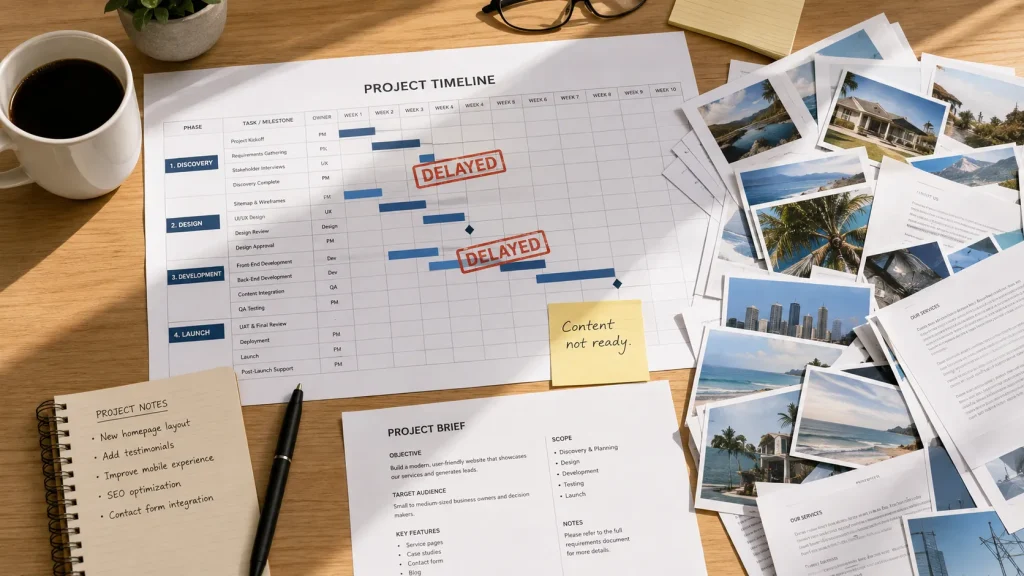
The pattern we see most often at TruTransit is straightforward: projects that start with content ready and a single decision-maker in place almost always hit their timeline. Projects that start without content, or with multiple stakeholders whose sign-off is needed at every stage, almost always run long.
What Should You Prepare Before a Website Project Starts?
The more prepared you are at kickoff, the faster and smoother the project runs. Here is what to have ready before day one.
Brand Assets
- Logo: In SVG or high-resolution PNG format, ideally in multiple color variants (dark background, light background)
- Brand colors: Hex codes if you have them. If not, three to five colors you want the site to reflect
- Typography: The fonts used in your existing materials, or a direction for the font style you want
- Existing brand guidelines: Even a basic style guide saves multiple revision rounds in the visual design phase
Content
- Page copy: Written text for every page on the site. If you do not have this, budget for a copywriter or expect the timeline to extend
- Photography: Real photos of your business, team, or product. Stock photography is a fallback, not a substitute
- Testimonials or case studies: Two to three client quotes or short case studies for credibility on service pages
- Core business information: Address, phone number, hours, service areas, and any certifications or credentials
Technical Access
- Domain registrar login: Access to wherever your domain name is registered (GoDaddy, Namecheap, Google Domains, etc.)
- Existing hosting account: If you have current hosting, confirm login access and whether you want to keep or migrate it
- Google Analytics and Search Console: If these are already set up, share access so the agency can verify or migrate tracking
Having these ready before kickoff is the single biggest controllable factor in your project timeline. Agencies build in wait time for content on most projects because experience shows it always takes longer than clients expect. Starting with assets in hand removes the most common source of web development delays entirely.
How Long Do More Complex Digital Projects Take?
Standard websites follow predictable timelines. More complex digital builds introduce variables that make timelines harder to estimate upfront.
How Long Does a Mobile App Take to Build?
A basic mobile app with a defined feature set typically takes 3-6 months from scoping to app store submission. A more complex app with real-time features, third-party integrations, or a custom backend runs 6-12 months. App store review adds 1-2 weeks on top of development completion. These timelines assume a dedicated development team; part-time or fractional teams extend them proportionally.
How Long Does a UI/UX Design Process Take?
A dedicated UI/UX design process for a web application or mobile product typically runs 3-8 weeks before any development begins. This covers user research, information architecture, wireframing, prototyping, and user testing. For simpler products, design and development overlap. For complex platforms, the design phase is completed and validated before development starts to avoid costly rework.
What About Website Redesigns vs New Builds?
A redesign of an existing site generally takes 80-100% of the time of a new build. The visual refresh is faster, but content migration, URL redirect mapping, and preserving SEO equity from the existing site add significant coordination. Businesses often underestimate the SEO complexity of a redesign. A proper redirect strategy is not optional if the existing site has any ranking pages.
Frequently Asked Questions
Can a website be built in a week?
A very simple one-page site or a pre-built template site can be live in under a week. A professional multi-page site with custom design and SEO setup cannot. Rushing a website build to an unrealistic timeline almost always produces a site that needs immediate remediation work or that underperforms because corners were cut on SEO, speed, or content.
Why is my website taking longer than the agency said it would?
The most common reasons are: content from the client side not ready when expected, feedback rounds taking longer than scoped, scope additions mid-project, or technical issues with domain or hosting access. Check which of these applies and address it directly. Most agencies want to hit timelines as much as you do. The bottleneck is usually on the client side more often than it appears.
How long does it take to add a new page to an existing website?
Adding a single page to an existing well-built site typically takes 2-5 days, including design, development, and content population. That assumes the brand style is already established and content is provided. A new page that requires new design patterns, custom functionality, or significant copy development takes longer. Ongoing maintenance agreements usually include a small number of page updates per month.
Does the platform (WordPress, Shopify, Webflow) affect the timeline?
Moderately. WordPress and Shopify are mature platforms with large component libraries, which can speed up development for standard builds. Webflow has a faster design-to-development cycle for visual builds but has limitations on complex functionality. Custom-built platforms take the longest because everything is built from scratch. Platform choice matters less than scope complexity and content readiness.
How long does it take to rank a new website on Google after launch?
A newly launched website typically takes 3-6 months to begin ranking for its target keywords, assuming it was built with proper on-page SEO and is producing consistent content. The first signals (impressions in Google Search Console) usually appear within 4-8 weeks of launch. Consistent rankings on page one for competitive keywords take 9-18 months for most new sites. SEO is a compounding strategy, not a launch deliverable.
Website timelines are predictable when the scope is clear and the client side of the project is prepared. The variables that stretch timelines are almost always manageable with a bit of planning before kickoff.
Know what you are building, prepare your content before the project starts, align on a single decision-maker, and ask your agency for a milestone-based timeline in writing. Those four things will protect your launch date more reliably than any other factor.
If you want a realistic timeline and scoping estimate for your specific project, get in touch with TruTransit Solutions. We walk through scope, content readiness, and a milestone plan in the first conversation so there are no surprises after the project starts.