

How Long Does App Development Take? Realistic Timeline for 2026

A simple app with basic features takes 2-4 months to build. A mid-complexity app with backend integration, user accounts, and payments takes 4-7 months. A complex app with real-time features, compliance requirements, or large-scale data systems takes 8-18 months. These ranges include discovery, design, development, testing, and app store submission. The most common causes of delay are incomplete specifications at the start, scope changes mid-project, and late design decisions, not slow coding.
Every founder asks this question early, and most get an answer that turns out to be optimistic. Not because developers lie about timelines, but because most projects start without a clear enough specification to estimate accurately.
This guide breaks down realistic timelines by app complexity, walks through what happens at each phase, and covers the factors that most commonly extend a mobile app development timeline beyond the original estimate.
How Long Does It Take to Build Different Types of Apps?
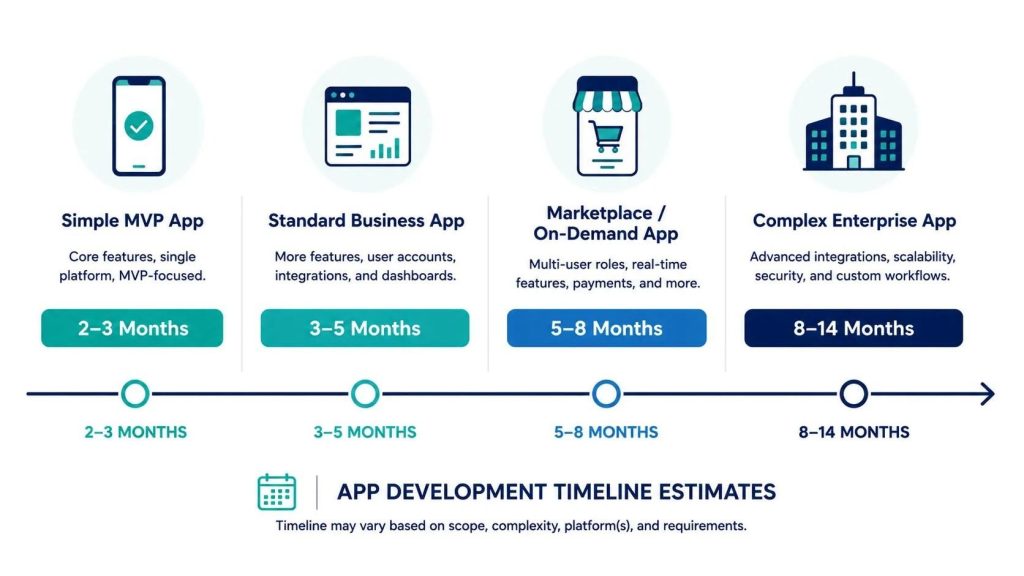
| App Type | Timeline | What Drives the Range |
|---|---|---|
| Simple informational app | 2-3 months | Number of screens, content management needs, basic notifications |
| Booking or appointment app | 3-5 months | Calendar logic, payment integration, admin dashboard complexity |
| E-commerce app | 4-7 months | Product catalog size, payment gateways, inventory sync, checkout flow |
| Social or community app | 5-9 months | User profiles, feeds, messaging, content moderation, notifications |
| On-demand service app | 7-12 months | Two-sided marketplace logic, real-time tracking, payment splits |
| Healthcare or fintech app | 8-14 months | Compliance requirements, security audits, regulatory review, integrations |
| Enterprise or SaaS platform | 10-18+ months | Custom backend architecture, multi-role permissions, scalability needs |
These ranges assume a dedicated development team working consistently on the project, not a part-time or fractional team, which extends timelines proportionally. A team splitting attention across multiple client projects will take longer per project than these ranges suggest.
What Are the Phases of App Development and How Long Does Each Take?
Understanding where time actually goes helps you evaluate proposals and manage expectations through the project.
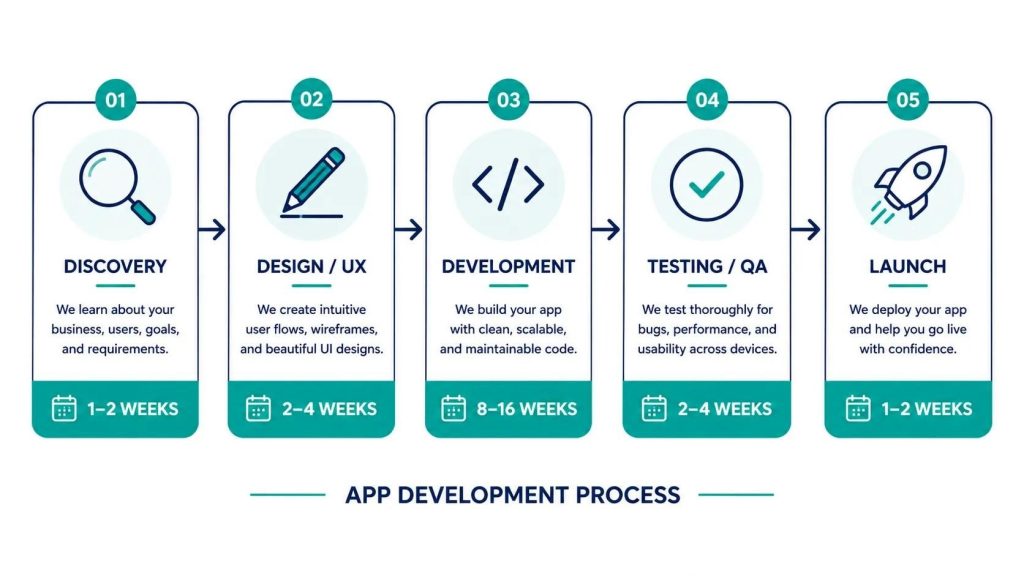
Discovery and Requirements (2-4 Weeks)
Before any design work starts, the team needs to understand the business goal, the target user, the core features, and any technical constraints. This phase produces a product requirements document and a feature prioritization list separating must-haves from nice-to-haves.
Skipping or rushing discovery is the single biggest predictor of timeline overruns later in the project. A vague starting spec leads to scope clarification mid-development, which is the most expensive and disruptive time to discover missing requirements.
UI/UX Design (3-6 Weeks)
Wireframes map the structure of every screen. Once approved, visual design applies colors, typography, and branded elements. For apps with complex user flows, a prototype is built and sometimes user-tested before development starts. This phase deserves real time. UI/UX design decisions made hastily here create rework during development, which costs more than the time saved at this stage.
Development (8-32+ Weeks Depending on Complexity)
This is where the bulk of the timeline lives. Front-end development builds the screens and interactions. Back-end development builds the server, database, and APIs the app depends on. For cross-platform apps, this phase covers both platforms simultaneously. For native dual-platform builds, this phase essentially runs as two parallel or sequential development tracks.
Development is typically broken into sprints, each delivering a working set of features for review. This iterative approach catches issues early rather than presenting a finished build at the end with accumulated problems. Cross-platform development generally shortens this phase relative to building two native apps in parallel.
Quality Assurance and Testing (2-5 Weeks, Often Overlapping Development)
QA testing covers functional testing (does every feature work as intended), device testing (does it work across different phone models and OS versions), and performance testing (does it run smoothly without crashes or lag). For apps handling payments or sensitive data, security testing is a distinct and necessary additional step.
App Store Submission and Review (1-3 Weeks)
Apple’s review typically takes 1-3 days per submission, but first-time submissions are rejected roughly 40% of the time for policy or guideline issues, requiring a fix and resubmission cycle. Google Play review is typically faster, often within a day, though apps flagged for manual review can take longer. Budget for at least one rejection cycle on iOS.
What Causes App Development Projects to Run Longer Than Planned?
| Delay Cause | How Common | How to Prevent It |
|---|---|---|
| Incomplete requirements at project start | Very common | Invest real time in discovery before development begins; do not rush this phase |
| Scope additions mid-project | Very common | Define a clear MVP feature set in writing; log new requests as a separate phase 2 |
| Design changes after development starts | Common | Get full design sign-off, including all states and edge cases, before coding begins |
| Third-party API delays | Common | Identify all integrations early; some require business verification that takes weeks |
| App Store rejection | Common on first iOS submission | Review Apple’s guidelines carefully before submitting; budget time for at least one resubmission |
| Slow client feedback turnaround | Common | Agree on a feedback SLA (48-72 hours) for design and milestone reviews |
| Underestimated backend complexity | Occasional | Have a technical architecture review before finalizing the timeline and budget |
The pattern across nearly every delayed project is the same: something that should have been decided during discovery gets decided during development instead, when changing it costs significantly more time and money.
Does the Development Approach Affect the Timeline?
| Approach | Relative Timeline | Trade-Off |
|---|---|---|
| Native iOS + Native Android (parallel teams) | Longest overall but each platform moves independently | Requires two specialized teams; higher cost; best platform-specific performance |
| Cross-platform (React Native or Flutter) | 30-50% faster than parallel native | One team, one codebase; minor limitations on hardware-specific features |
| No-code or low-code platforms | Fastest for very simple apps | Limited scalability and customization; not suitable for complex business logic |
| Single platform first, second platform later | Fastest to first launch; total combined timeline is longer | Validates the product before committing to full dual-platform investment |
For most businesses balancing speed and budget, cross-platform development or a single-platform-first approach both compress the timeline to market without sacrificing core functionality. The right choice depends on whether your priority is reaching both platforms immediately or validating the product with one platform first. Either approach connects to the broader mobile app development cost conversation, since timeline and budget move together.
How Can You Realistically Shorten Your App Development Timeline?
Some timeline compression is genuinely possible without cutting corners that create future problems.
- Reduce the MVP scope: Launch with the smallest feature set that delivers real value, and add features in version 2 based on actual user feedback
- Use established design patterns: Custom, novel UI patterns take longer to design and build than well-established, familiar app interactions
- Choose cross-platform over parallel native: This is consistently one of the largest single timeline reductions available
- Prepare content and assets in advance: Have copy, images, and branding ready before development starts rather than mid-project
- Commit to fast feedback cycles: A team that responds to review requests within 48 hours keeps the project moving; multi-week feedback gaps compound across every milestone
- Front-load technical risk: Identify and resolve the highest-risk technical unknowns (complex integrations, novel features) early rather than discovering blockers late
Frequently Asked Questions
Can app development be rushed for an urgent launch deadline?
To a limited degree. Adding more developers to a project has diminishing returns, a well-documented phenomenon in software development where communication overhead increases faster than output. The more reliable way to hit an urgent deadline is reducing scope, not adding people. A smaller, well-built MVP delivered on time outperforms a feature-rich app delivered late or rushed into a buggy launch.
Why do some apps take a year or more to build?
Apps with regulatory compliance requirements (healthcare, fintech, insurance), complex multi-sided marketplaces, custom AI or machine learning features, or enterprise-grade security and scalability needs genuinely require more time. The complexity is not artificial. Compliance audits alone can take months, and integrating with legacy enterprise systems often surfaces unexpected technical challenges that extend timelines beyond initial estimates.
Does hiring a bigger development team make the app faster?
Only to a point, and the relationship is not linear. Doubling the team size does not halve the timeline because coordination and communication overhead grows with team size. For most small to mid-size apps, a focused team of 3-6 people (project manager, designers, developers, QA) is more efficient than a larger team. Adding people mid-project to compress a timeline is generally less effective than people expect.
How accurate are app development timeline estimates?
Estimates given after a thorough discovery phase, with a clear feature specification, tend to be accurate within 10-20%. Estimates given quickly, based on a brief conversation without a detailed spec, are frequently off by 50% or more once development reveals the actual complexity. The accuracy of a timeline estimate is directly tied to how much real scoping work happened before the estimate was given.
What is the fastest realistic timeline for launching a basic app?
A simple, well-defined app (5-10 screens, basic functionality, no complex backend) with a dedicated team and content ready at kickoff can launch in 6-10 weeks using a cross-platform framework. This is an aggressive but achievable timeline for genuinely simple apps. Anything more complex than a basic content or utility app will not realistically launch faster than 3 months without cutting quality or scope corners that create problems after launch.
App development timelines are predictable when the scope is clear from the start. The variance between projects comes down almost entirely to how much clarity exists before development begins, not how fast any particular team can type code. This holds whether you are building a standalone app or pairing it with a website and broader digital presence.
Invest in discovery, commit to a defined MVP, and choose the development approach (cross-platform versus native) that matches your actual priorities. Get those right and your timeline estimate will hold.
If you want a realistic timeline and scope estimate for your specific app idea, get in touch with TruTransit Solutions. We run a proper discovery phase before quoting any timeline, so the estimate you receive reflects your actual project.