

What Is Cross-Platform App Development? Costs, Benefits & When to Use It

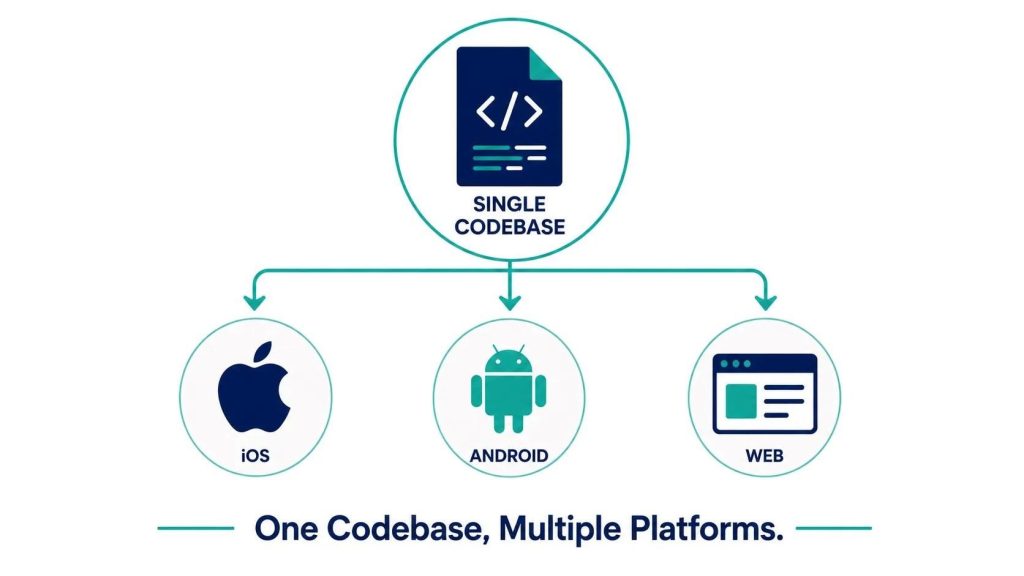
Cross-platform app development is the practice of building a mobile app from a single codebase that runs on both iOS and Android, rather than building two separate native apps. Frameworks like React Native and Flutter make this possible by compiling shared code into platform-specific apps. It typically costs 20-40% less than building two native apps and cuts time to market significantly. The trade-off is occasional limitations with highly performance-intensive features or deep native hardware integration, though this gap has narrowed substantially in recent years.
Building a mobile app used to mean choosing one platform or paying for two complete development efforts. Cross-platform development changed that equation by letting a single codebase produce apps for both iOS and Android.
This guide explains how cross-platform development actually works, what it costs compared to native development, and the specific situations where it makes sense. If you are scoping a mobile app development project, this decision affects your budget and timeline more than almost any other early choice.
How Does Cross-Platform App Development Actually Work?
A cross-platform framework lets developers write the application logic and UI once, in a shared language, and then compile or render that code to run natively on both iOS and Android. The two dominant approaches today work differently under the hood.
React Native: JavaScript Bridge to Native Components
React Native, built by Meta, lets developers write app logic in JavaScript or TypeScript. The framework then renders actual native UI components (buttons, lists, navigation) on each platform, communicating between the JavaScript layer and native code through a bridge (or the newer JSI architecture). The result looks and feels native because it is using real native components, not a simulation.
Flutter: A Self-Contained Rendering Engine
Flutter, built by Google, takes a different approach. It uses the Dart language and draws every pixel of the UI itself using its own rendering engine (Skia, transitioning to Impeller), rather than relying on each platform’s native components. This means a Flutter app looks identical on iOS and Android because it is not using either platform’s native UI library at all.
Both approaches achieve the same goal: one codebase, two app store deployments. Choosing between them is a separate decision covered in more detail in our React Native vs Flutter comparison.
What Are the Main Benefits of Cross-Platform Development?
| Benefit | What It Means in Practice | Typical Impact |
|---|---|---|
| Lower development cost | One codebase instead of two separate native builds | 20-40% cost reduction versus building both platforms natively |
| Faster time to market | Features are built once and shipped to both platforms simultaneously | Launches typically 30-50% faster than parallel native development |
| Easier maintenance | Bug fixes and updates apply to both platforms from a single change | Reduced long-term maintenance overhead and fewer platform-specific bugs to track |
| Smaller team requirement | One team with cross-platform skills instead of separate iOS and Android specialists | Lower hiring complexity, especially for early-stage teams |
| Consistent UX across platforms | Easier to keep feature parity and design consistency between iOS and Android | Reduces the risk of one platform falling behind the other in features |
| Code reuse for future web app | Some cross-platform code can extend to web (React Native Web, Flutter Web) | Potential additional savings if a web version is planned |
What Are the Trade-Offs of Cross-Platform Development?
Cross-platform development is not the right answer for every project. Being honest about the limitations helps you make the right call.
Performance for Graphics-Intensive Apps
Apps with heavy animation, complex 3D graphics, or real-time gaming mechanics still generally perform better when built natively. Cross-platform frameworks have closed much of this gap, particularly Flutter with its own rendering engine, but for the most performance-demanding use cases, native development retains an edge.
Access to Brand-New Platform Features
When Apple or Google release a new OS-level feature, native development gets access immediately. Cross-platform frameworks need the framework maintainers to add support, which can lag by weeks or months. For most business apps this delay is irrelevant. For apps that need to be first to adopt new platform capabilities, it matters.
Native Module Dependency for Hardware-Specific Features
Deep integrations with platform-specific hardware (advanced camera controls, certain Bluetooth protocols, specialized sensors) sometimes require writing native code bridges even within a cross-platform app. This adds complexity back into the project, though it is usually limited to specific features rather than the entire app.
How Much Does Cross-Platform Development Cost Compared to Native?
| Approach | Relative Cost | Time to Launch Both Platforms | Best For |
|---|---|---|---|
| Native iOS + Native Android (separate teams) | Highest (100% baseline) | Longest; built in parallel or sequentially | Apps requiring platform-specific UX or maximum performance |
| Cross-platform (React Native or Flutter) | 60-80% of native cost | 30-50% faster than building both natively | Most business apps; startups; budget-conscious launches |
| Cross-platform with select native modules | 70-85% of native cost | Slightly slower than pure cross-platform | Apps needing 1-2 specific hardware integrations |
| Single platform native (iOS or Android only) | 50% of dual-native cost | Fastest for one platform | Validating a product before committing to both platforms |
For a mid-complexity business app that would cost $60,000 to build natively for both platforms, cross-platform development typically lands in the $36,000-$48,000 range. The exact savings depend on how much platform-specific work the app ultimately needs. A detailed mobile app development cost breakdown helps set realistic expectations before development starts.
Which Types of Apps Are the Best Fit for Cross-Platform Development?
Cross-platform development is the right default for most business apps. Specific categories where it consistently performs well:
- Content and information apps: News, blogs, directories, and reference apps with standard UI patterns
- Booking and scheduling apps: Calendar logic, forms, and notifications work well in cross-platform frameworks
- E-commerce apps: Product catalogs, cart, and checkout flows are well-supported with mature payment integration libraries
- Social and community apps: Feeds, profiles, and messaging features have strong library support in both major frameworks
- Internal business tools: Dashboards and workflow apps for employees rarely need platform-specific performance
- MVPs and early-stage products: Validating product-market fit quickly across both platforms before committing to a larger native investment
Where native development is still the stronger choice: high-end mobile games, AR/VR applications, apps requiring deep integration with niche hardware, and apps where platform-specific design language is a core part of the brand experience. For UI/UX design that depends heavily on each platform’s distinct visual conventions, native or React Native (with its native component rendering) tends to fit better than Flutter’s unified rendering approach.
How Do You Decide Between Cross-Platform and Native for Your Project?
Run through these questions in sequence.
- Is your budget the primary constraint? Cross-platform is the clear answer if cost is the limiting factor.
- Does your app depend on graphics-intensive performance or AR/VR? Lean native, or at minimum, plan for native modules within a cross-platform shell.
- Do you need to launch on both platforms simultaneously? Cross-platform is almost always faster for simultaneous dual-platform launches.
- Is this an MVP to validate an idea? Cross-platform lets you test on both platforms without doubling your initial investment.
- Does your team already have strong native iOS or Android expertise? Leveraging existing skills natively may outweigh the cross-platform cost advantage.
Most business apps answer these questions in favor of cross-platform. If you are still unsure after working through them, a brief technical consultation with a mobile development team that builds in both approaches can clarify the right path for your specific requirements.

Frequently Asked Questions
Can a cross-platform app be converted to native later if needed?
Not directly, but the product design, business logic, and backend architecture from a cross-platform build transfer to a native rebuild. You are not starting from zero. A typical path is launching cross-platform to validate the product, then rebuilding natively for one or both platforms once usage and revenue justify the additional investment. This is a common and reasonable growth path rather than a sign the original decision was wrong.
Do users notice the difference between a cross-platform app and a native app?
For most well-built apps, no. React Native apps use real native UI components, so they look and feel native because they are. Flutter apps are visually consistent but distinct from each platform’s native look, which most users do not notice or mind unless they are specifically comparing it to platform conventions. Poorly built cross-platform apps with laggy animations or unresponsive interactions are noticeable, but that is usually a development quality issue rather than an inherent limitation of the framework.
Which big companies use cross-platform frameworks in production?
Major companies using React Native include Meta, Shopify, Discord, and Walmart. Companies using Flutter include Google Pay, BMW, eBay Motors, and Alibaba’s Xianyu marketplace app. These are large-scale, high-traffic production apps, which demonstrates that cross-platform frameworks handle serious commercial workloads, not just simple MVPs.
Is cross-platform development faster to update after launch?
Yes, generally. A single codebase means bug fixes and feature updates apply to both platforms at once, reducing the time between identifying an issue and shipping a fix to all users. Native development requires the same fix to be implemented twice, once per platform, which doubles the testing and release overhead for every update.
What happens if the cross-platform framework I choose becomes outdated?
Both React Native and Flutter are backed by major companies (Meta and Google respectively) with strong long-term investment and large existing production codebases depending on them. Neither framework shows signs of being abandoned. The realistic risk is not framework death but framework evolution requiring periodic updates, similar to how any actively maintained software stack requires updates over its lifetime.
Cross-platform development is not a compromise choice anymore. For the large majority of business apps, it delivers a comparable user experience at meaningfully lower cost and faster time to market than building two separate native apps.
The decision to go native still makes sense in specific, identifiable scenarios. Outside of those scenarios, cross-platform is the practical default for most app projects launching in 2026.
If you are scoping a mobile app and want a clear recommendation on cross-platform versus native for your specific project, get in touch with TruTransit Solutions. We build in both approaches and will recommend the one that fits your budget and goals.
6 Responses
This platform has completely changed how I enjoy my free time. The interface is super smooth and the support team always responds within minutes. I highly recommend giving it a try. eccasinoonline
Thank you for your feedback! We’re glad to hear you appreciate a smooth user experience and responsive support. We appreciate you taking the time to share your thoughts on our blog!
Namaste and welcome to a platform that truly respects our time and money. I have played on many apps across Dhaka and Chittagong and this one handles local currency deposits without any hidden fees. The cricket matches are covered instantly and the interface is super clean. bdtabaje
Thank you for sharing your feedback! We appreciate your kind words about the user-friendly interface and overall experience. Thanks for taking the time to leave a comment on our blog!
Mantap banget guys! I searched for months and this one finally feels truly reliable. Deposit limits are flexible and the service team uses local slang which makes chatting so easy. Love the community vibe. inbg6666
Thank you for your wonderful feedback! We’re happy to hear that you appreciate the friendly service and welcoming community. Your support means a lot to us, and we look forward to providing you with a great experience!